Boo boo in select company

Boo boo in select company
Something to say?

Thursday, 2 December 2021

Adichie, The Purple Hibiscus, and Kambili's Father


Chimamanda Ngozi Adichie – My favourite author.

I came upon Adichie’s PURPLE HIBISCUS by chance. One of those surprises reading addicts come upon, surfing through Goodreads or Amazon in a fallow week. I suppose the fact that the story was set in Eastern Nigeria helped.

   I lived in Enugu and Ikot Ekpene for five years, from 1962 to 1967. If you could probe into my psyche, you may find that I am, at the core, a lot African, a little Eastern Nigerian. I taught at two teacher-training colleges run by Irish (Holy Rosary Training College), and American (Holy Child College, Ifuho) nuns. You may even decide I am not very impartial when I talk about Nigeria. Mea Culpa.

   Nevertheless:

   I found Nigerians kind, compassionate, hospitable and tolerant. At Ifuho, I had many Nigerian friends. The young practising teachers came to my house regularly. They introduced me to Nigerian food and music and took me ‘shopping’ in the waste ground in town they called their market. I was searching for coconut oil for my hair, in typical Keralam fahion. I remember urchins tugging at my long knee-length plait – was it real? What I got was palm oil; my hair did not disagree with palm oil.

   Adichie’s story of the girl, Kambili, and her mother and brother, bullied by their father, is told with grace, humour and empathy. Not to mention the unmistakable skill of a great writer. However, the father is not your typical Nigerian man. It is a bit like saying all Romans are Nero. Or, all British people are buffoons like Boris Johnson. Let’s not go there.

   I have a Nigerian neighbour – when I am alone in my house sometimes in the night, because my family is out of town, I go to them. I sleep there. When I lost my little girl in Nigeria, the Nigerians held me up; they helped me out of that dark tunnel, which is bereavement.

   So, do not, please, lump all Nigerians with one character, in a novel.


Friday, 26 November 2021

Getting Married, 1957 Style

  This is me getting married, in 1957

My grand niece is getting married on the 19th December. She is up to her neck in nuptials related planning – wedding dress, will it arrive on time? The party after – how many and who? Personal beautification – nails, hair, face, feet… No wonder she is stressed.

   I have never got my nails ‘done’ in my lifetime. When I was small, Achan clipped my fingernails for me with a discarded razor blade. I cannot remember suffering an injury in the process. My hair was ‘cropped’ by a barber in town, until Achan decided to let it grow long. I looked like a boy and got all the boy roles in school plays until I was thirteen years old.

   I went to hair stylists after I came to the U K, and my long hair became impossible to wash and dry daily as in Keralam. Some years later, I started resenting the cost of chopping off bits of hair here and there, with no discernible improvement in looks. I have not been to a hair-dresser for many years now. I take my kitchen scissors to my hair now and then; occasionally my daughter tidies that up a bit, with a long-suffering grumble.

   But my niece is getting her nails ’done.’ I remembered me dressing up for my wedding:

               Wash early and dry your hair, my aunt instructed. The jasmine won’t like wet hair. Right. There would be a jasmine fest, I knew that.

               An hour before the ceremony, which took place in our front yard, in front of all our friends and family, my cousin, Mani, plaited my knee-length hair, grumbling all the while about it still being wet. She then coiled it up in a kondai and put a foot-length of a jasmine garland around it.

               I dusted some Cuticura powder on my glistening face, put a red dot on my forehead with a liquid paste, and used my forefinger to line my eyes with kajal. All done.

                Then I wound the Benarasi white-and-gold sari (the costliest I had ever owned at 105 rupees) round my waist, put a nappy-pin on my gathers at the waist, and I was ready. The gold thread in the sari gave my face its glow.

               In India, now, middle-class weddings have become extravagant shows – shows of influence and wealth on the part of the bride’s family. The ceremony takes place in a wedding hall, dedicated to weddings. The bride is covered in gold jewellery and a professional make-up artist dresses her hair and face. There might even be a manicure and a pedicure. Jesus wept!

               My grand niece is a clever girl – she is keeping a tight hold on the wedding expenses. She is managing the entire process, with no immediate family to help. I wish I was there.

               This girl is my friend and a member of my family. I have great faith in her ability to get things, in the end, right.


Sunday, 14 November 2021

Our Bosses -- the Animals


The Three Cat Tessellation


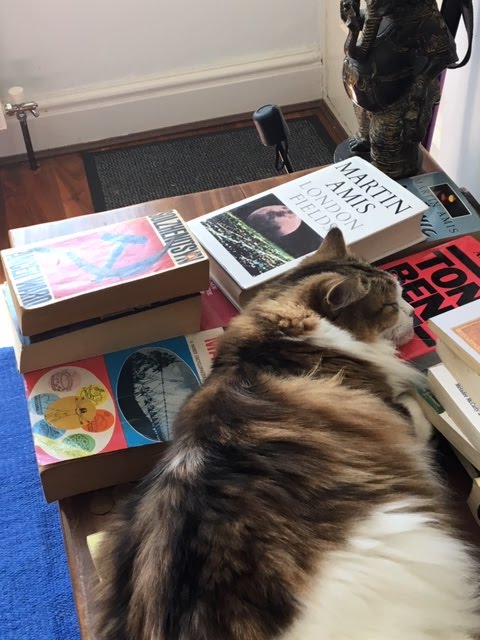
I cannot imagine a home without animals. In our house, who owns who is always debatable. When our fluff, Booboo, perches on Kitta’s knee when he is marking a hundred university scripts; when Pepper, my cat, complains as I move my legs in bed (My legs are solely for her to sleep on at night.); when the mutt, Lily, nudges my daughter’s legs aside on the sofa so that she can curl up in her lap, the answer is crystal clear.

   I often wonder how it is that some families love animals and some don’t. Genetic, or exposure to pets early in life?

   Next to our house in Thalassery there was a Chayakkada. Men going to work at building sites or factories stopped there, on their way, to get a hot cup of chai; my aunt said they probably never bought tea leaves or  milk for their households, the morning drink generally being yesterday’s conjee. The chayakkada was a tiny roadside veranda and a small room with two rickety benches in it. It was run by a man called Kumaran, and when he washed his tea-pan out, he swung the dregs on to the road.

   He had some saving graces. Every six months he would have another litter of kittens to give away, all fluffy-tailed and long-furred. They went quickly; in passing our household got one or two. Achan disapproved of cats saying they caused asthma, but he was on a losing wicket. When he was near we hid the kittens under the gatherings of our pavadas (long skirts) or later, my sari. Sometimes the kitten gave the game away by purring on my stomach.

   My first cat was named Sundari. She was all white and had a beautiful face. The next one was Beauty, which meant the same thing. They had pretty faces and plentiful fur. They disappeared often down the road, scavenging at houses where fish was being scaled and finned, but returned to puke on our doorstep. Eventually, they would disappear into cat paradise – I would call their names without a miaow in reply.

   The last one was Mimi; when I got married and left, my father, who maintained he disliked cats, arranged for the fisherman to feed her daily.

   In my husband’s home, no animals were allowed. My husband’s parents did not like them either. So, it was not until I became single again that I got another animal. Leone and Makeni, the two dogs were named, after my favourite places – Makeni is in the north of Sierra Leone. I had to give them to friends to keep when I left Uganda for good. It broke my heart and I vowed never to get another animal.

   Next year, in Zambia, (1993) I got Inji (Malayalam for ginger)– a majestic ginger tabby. By now, I could afford to take my cat with me, so Inji went with me to Malawi. Meanwhile my daughter, who was also in Malawi, had acquired another kitten – Ammu. A boy was holding some kittens up at a roundabout; predictably, she fell for it. Ammu drove Inji mad cavorting all around her and got frequently swatted. She came with us to England. Inji died of a kidney disease in Malawi, and Ammu became road-kill in Croydon.

   In Croydon we got Tyson and Louis, (we never learn) forever fist-fighting as kittens. My little granddaughter called them Tyson and Nui-nui. Two road-kills again. I vowed I would never get a kitten again, but my daughter came back one day with Booboo and Pepper, two tiny kittens that hid under a cupboard in the kitchen, until they were really hungry, and came out to eat. They are still with us, now five years old. Pepper sleeps on my bed and Booboo pesters my son.

   There was also Keeri, whom I got in Kochi, and I brought home to England with me. She was adorable, intelligent and followed me around. She slept on my right shoulder generally, and would scurry up to bed with me. She also got run over in 2015. Now, my daughter won’t let me get another kitten. ‘They all die,’ she says.


   We have Lily instead, a long-suffering, loving dog that does not recognise that she is not human. She is also thoroughly spoilt. We are right suckers for animals.

   I’d love another Bengal-kitten like Keeri.
Saturday, 13 November 2021


Christmas and I

 In Thalassery, my hometown in Keralam, Christians were in a negligible minority. On Court Road, where I lived, there was just one family – that of Mabel and Ida. Mabel was my age and one of my closest friends. We walked to school and college together. Our families knew everything about each other. Her father, Earnest, a lawyer like my father, was my father’s friend and the three of us children, and two fathers, often went to the local beach together.

   So, Christmas was not a memorable event. But Mabel’s Mummy always sent us home-baked Christmas cake, and I often had a lavish Christmas dinner in their home. That was about the size of our Christmas. Mabel’s family attended midnight mass at the local Methodist Church. We didn’t exchange gifts or cards; no one had that kind of spare money then.

   When I got married to Balan, and went to live in Colombo, the texture of Christmas underwent a sea-change. My husband’s urban family, though Hindus, celebrated Christmas with gifts for the children in the family. So, I was drawn into the obligation of gifts for Balan’s nephews and nieces. The more westernised wings of the family went to Christmas balls and Balan’s British employers hosted a lavish celebration at the luxurious Galle Face Hotel every year. I went, but never having danced anything but Bharatha Natyam before, lurked at the sides of the ball room, and was glad to make my escape before the revelry became raucous.

   When I had children of my own, Balan would bring gifts home. Sometimes sparklers. In Nigeria and Zambia, we often went to the houses of our Christian friends for dinner; it was all very low key.

   When did it escalate into this money-eating monster? I hardly noticed the transformation, The deluge of packing paper at the end of Christmas week always irritated me. I didn’t see the point. But my grand daughter begged for Christmas trees and baubles, as soon as she could talk, and we obliged. Now she’s past the baubles stage; spending-money is much more in demand. Phew! As they say.

   This year, we shall give her some money and let Christmas skid past. As usual, I shall have dinner with Mary and Michael. Any excuse to enjoy their cooking and the company of the two families together. We met up in Zambia in the late sixties and her mother hosted the fancy dinner. Our children grew up in each other’s houses.

   So, the ritual persists. Perhaps that is what it is about – bringing family and friends together over a rich dinner.  I will settle for that.


The Sound Track to my Life

 Our Philips radio, the Bakelite monster, was the first on our street, Court Road, so called because the District Courts were just a hop, skip and a jump away. It arrived in 1945, a year after electricity in the houses. I remember hearing about Gandhiji’s assassination on that black and brown box, and the whole neighbourhood crowding into our corridor, weeping while they listened. It had big dials in front and needed a great deal of tender coaxing and fiddling before it surrendered its news-nuggets. 

     I remember Nehru making that famous ‘Tryst with Destiny’ speech, at midnight, on the ramparts of the red fort, the day India became independent in August, 1947. ‘At the stroke of the midnight hour, when the world sleeps, India will awake to life and freedom...’ The hair on my arms stood on end.

   Transistor radios arrived while I was living in remote Ikot Ekpene. I got one in 1964 for my father when I travelled to India after my first tour – if you were Indian in those days, the whole point about going overseas was to return with as many electronic gadgets as you could carry in your hand-luggage, wires trailing down the gangway. You walked down the narrow aisle in an aeroplane knocking down passengers right and left with your loot.

   The radio, in one shape or another, has come to stay in my life. In all the African countries I worked, the World Service heralded my day in, and I slept, at the end of the day, to the world news, in the dulcet tones of another privileged gentleman (no women then) with cut-glass accents. On an insomniac night, the national anthem and our gracious queen put me to sleep. They bred the news readers specially, I used to think, in exclusive enclaves, to confound the world.

   Radios got smaller with the years, and now, I have a tiny unobtrusive white companion which is always within hands-reach when I sleep. When I travel, it is the first object I pack along with my pills and potions of senility, and my multiple sticks for support.

   When the little box, quite ugly in white plastic, is not near me, I fret and fidget till I get it back to where it belongs. At the moment it is all agog about Afghanistan. I am waiting for that day when it tells me that our slippery P M has gone AWOL for good.


Sunday, 7 November 2021

 Street lights arrived in Thalassery around 1943. You had to buy a connection to the house, so by 1947, we had electric lights in the veranda, the corridor and Achan's room upstairs. The 40 watt bulbs didn't do much, so Achan also had a small lamp clipped to the headboard of his bed, by which we both read.

   Naniedathy cooked with firewood and debris from the coconut palms, which smoked a lot when lighted. This was a fallback when we ran out of firewood. Krishnan, the rickshaw wallah took me to school and later, Usman, who had T B and coughed a lot. The first car owner on the road was my father, it was a small second-hand Morris minor, with a sliding panel in the roof for when it got too hot in the car. When it rained that panel let the rain in.

   Life was paired down. In all of Thalassery there were four cars and these were owned by doctors. There were no supermarkets -- fish and meat were sold in a covered hall in the centre of town; often the fishermen or women brought it to our houses for sale.

   The carbon footprints were barely visible. Now, we have two cars in the driveway and lights blaring in empty rooms all over the house. In our small way we have all contributed to the looming climate catastrophe. And listening to the 'leaders' at the COP26, I cannot imagine anything much is going to happen.

   In our house, we are going to use the car less, not leave lights on in empty rooms. Maybe organise a rota so that our children share cars to school, with families down the road. Another thought: we could boycott companies who are carbon-profligate by not buying their goods. The only place we can persuade business is in their wallets. During the Freedom Movement in the forties in India we had some success with not buying imported goods. This was piecemeal, more gesture than a major event. But gestures are important too. Perhaps this is a battle which can only be won at street and family level.

   I wonder what the young ones will do next. Greta Thunberg is quite a force.

Friday, 29 October 2021

COP26 and ROBBERS?

 So, it's on starting Sunday. Hope the canapes are artistic, the three-course meal delicious and the desserts out of this world. All, of course cooked with no fossil fuel in sight. I have been to a few of these get-togethers of African countries in Africa -- the representatives from the poorer parts of Africa took the daily allowances and saved it to take back to their households. 

  Our accommodation would be paid for by our sponsors, so we stayed in 4-star hotels in places like Blantyre and Freetown. I would go down to the hotel dining room for a meal, (I was earning an expatriate wage) but my counterparts ate the meagre food they had brought from their homes. I would have to personally drag them to the dining room and offer to pay for their meals, to salve my high-earning conscience.

  I am delighted the countries are meeting to plan their behaviour in the coming years. Occasionally, I wonder what fraction of the Paris Agreement got adhered to by the Big Guns. I am hoping this COP 26 will not be another shower of the nitrogenous stuff. Are they planning for ways of monitoring the post-COP behaviour of the rich and the greedy?

  China has agreed to make an appearance, but apparently it is only making a token attempt to plan the reduction of its carbon emissions. Our esteemed leader spoke to the Chinese President today. Well Done! Except Mr Xi  Jinping would not have been impressed by our P M's stuttering and stammering.

  I have often wondered what exactly our esteemed P M actually cares about. Not the poor of this country, not the 'to be levelled up' North of this nation, and certainly not his blond thatch. Sometimes I think he sleeps in his trousers and walks out without ceremony, entitled, to the parliament or wherever. Somebody should buy him a hair brush. 

  Can we trust Boris Johnson to WORK for a successful execution of COP 26? WORK is not a word he likes. Alok Sharma will be the in the limelight. I hope he is able to bring the gathering together, including the robbers who are out only for their own profit.

  Greta (what a girl!) is out and protesting -- I hope she can keep the so-and-sos in line. As for me, I've always believed all of us can do our bit:

    switch to electric cars or use public transport; plant trees, respect our wild and wondrous places, teach our next generation about climate change and how it affects their world...

  We need to remember that this world is all we have, it belongs to all the living creatures on it now and in the future, and its resources are NOT for the rich countries to seize and gobble. UK's history in this respect has been shameful. We have a long way to go to redeem ourselves.