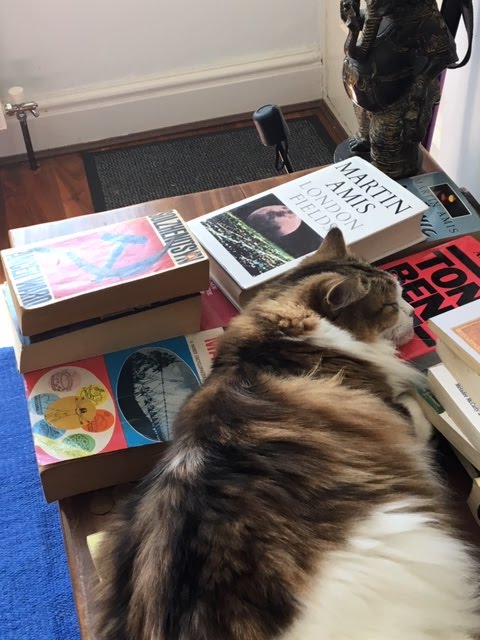
Boo boo in select company
Something to say?
Thursday, 9 September 2021
A Dietary Deficiency
Sunday, 5 September 2021
Teachers' Life
Teachers' day. Now, there's a thought. I was a teacher from 1963 to 1998. Actually, I never stopped being one. That tone - pedantic and authoritarian, does not please my children. Actually, the best teachers' days in my view are Saturdays and Sundays. Bliss to get up late, hang around in a housecoat all day, drink lethal numbers of cups of tea...
I was a smorgasbord kind of teacher -- I taught Secondary School, Primary school, Teacher Training college and nipped at the heels of University without much success. Too much like work, that last one. Until the British Council gave me a fancy name ('Maths Adviser -- deceived no one) and sent me to Africa to educate the 'natives.' Who knew a lot more Maths than I did, and a great deal more about how to train teachers without any resources other than a blackboard and chalk . One wag said to me, 'Just give us the money and go away, Anand.'
Uganda, for instance, put up with me with genuine affection and a smidgen of amusement. One day, the Makerere University lecturers invited me to one of their parties. No women around; I think I was a honorary male. They exchanged stories about the Tanzanian soldiers marching in to get rid of Idi Amin and the bombs whizzing past the top of the flat where we were meeting.
These guys were seriously clever, one of them had two Ph.Ds in Maths. Why two, Omurotu? I asked. Scholarships, he said. Whenever one was offered, I took it. The second one was in India and he came back with the Indian habit of wobbling their heads, which is often caricatured on T V in England. In the process of those two five-year scholarships, he lost his wife -- she gave up waiting around and left.
All the Maths syllabuses in Africa were too ambitious at Secondary level and sometimes at Primary level. Often the teachers at Primary level, who taught all the subjects to one class, did not have enough Maths in them to manage the aspirations of the Ministry of Education.
My first job was to get some consensus about what needed to be taught, when. Simultaneous Equations in Primary 5?? Jesus wept!
It was in Nigeria, in a tiny little town called Ikot Ekpene, on the Aba road, that I started my teaching career. My salary was nineteen pounds a month. It was a girls' training college and I loved walking into my first classroom of The Sacred Heart College, Ifuho. The college was run by American Catholic nuns, and all the girls had to wear uniforms -- brown pinafores over white blouses. Skirts had to touch the floor when the girls knelt for prayer, which was many times during the day. But that dirty brown on polished dark complexions?An abomination. Grass green is what I would have voted for.
They stuck their pens into their tight curls and firmly believed that my long knee length plait was an add-on. Until someone gave it a tug and it didn't come off.
That was just the beginning in Nigeria. I lasted five years in that country, until the Biafran issue brought war and destruction. We fled, leaving possessions behind.
I can see there is a great deal to talk about my peripatetic teaching life still to come. Zambia, Sierra Leone, ... Even Wickford in entrancing Essex. So, the rest in part two, if you don't mind.
Tuesday, 31 August 2021
Educating Anandam
I remember that day. I had planned to go to the house behind ours , where two of the aychees (sisters) of my choice lived. Madhavi with never-ending patience for me, and Naani, the opposite. Nani would flip if I ran around her kitchen -- the pots were on three-stone fires, with dry coconut fronds for firewood. I also had a reputation (well-justified) for snatching handfuls of grated coconut off the grinding stone, where it was sitting ready for the daily fish curry.
In my home there was no compound to run around in. Next door was surrounded by generous tracts of land whichever way you looked. I like the south side best, which had multiple attractions for a girl of eight years. The huge Tamarind tree whispered in the breeze and tempted me to talk to it and dwell under its huge shade. I could pick the wind-falls and nibble at the sharp tangy fruit. Madhavi was always warning me how there would be blood in my poo if I ate tamarind, but it was too tasty to reject.
The land furthest from the house was terraced towards the end, where there was a fence, on which wild, pink, Yeshoda flowers grew plentifully. The flowers had long stems such that I could make garlands by plaiting the stems. Then there was the forbidden treat of looking through the vines at the plot next door.
A family of Parayas ( untouchables, so called, then) lived there. It was a clan rather than a family; at least thirty people who lived in bamboo-and-thatch lean-tos. During the day the women were always cooking huge clay-pots of food, and the men quietly congregating in shady ground, drinking toddy. At night,the drumming would start and we could hear singing and celebration, when the traffic noises on our road had died down. In the late forties the land was acquired by a lawyer, who built a beautiful house there Where did the Parayas go? The next empty plot of land probably. I like to think that, with Independence, they prospered, the children went to schools...
As an only child, I had to create my own entertainment -- did that lead me in the direction of undue dependence on the written word? An uncle taught me Patience, a card game which I could play on my own with a pack of dog-eared playing cards discarded by my father and his '28' crew. There was also the tiny green pods shed by the Arecanut tree, which I collected to play chottu kali, flicking one on to another with forefinger and thumb.
But, on that day, Achan found me early, just after I had eaten my dosha and sammandi. He was going to teach me public speaking. He would give me a topic and I had to prepare a three-minute speech on the subject. To be delivered on the long walkway in front of our house. Part of my education!
The people wandering past our house would stop and stare at us, while my father threw useful suggestions at me. Slow down, throw your voice etc. The children from the houses on the left and right of our home would line up and gawp. There was no escape. This was all part of my 'education according to Achan.'
GOT IN THE WAY OF MY GAMES and FORAYS NEXT DOOR.
Thursday, 19 August 2021
War brings my cousins home
My uncle, Achan's elder brother, Sankaran Velyachan,, ran away to Malaya, in his late teens. He had good reason to run, rumour hath it. A maid in his house got pregnant and he might be forced to marry her, being the only bachelor in the house. So, he persuaded his sister to part with her gold necklace, sold it, and bought tickets to Malaya, before the elders in his household had added 2 and 2 to make 5.
A few years later, in Singapore, he became a doctor, licensed to practice medicine. This was not an uncommon story in the nineteen-twenties. From my father's family, two more young men ran away in search of fame and fortune. One worked in the post office in India when he returned home in the late forties after the war in the East had ended. The other didn't wait for the war to end; he returned to Madras (now called Chennai) in 1944, in a Japanese submarine, armed with many toys-for-spies. Actually, he just wanted to go home; he abandoned his spying goodies on reaching Madras, and forever after, was known in his village to which he vanished, as Japan-Balan. He was my father's nephew and I I knew him well. He was handsome, lazy, good-natured, and often drunk. But, there was no guile in him.
During the second world war many families were split up, with the men stranded in Burma, Persia or Malaya. My uncles's wife, however, was with him when the war started. He was in Penang and Singapore and Sungei Patani, working in rubber estates, until he returned to India after six years, with many hair-raising tales about the Japanese army in Malaya.
Photo specially taken for the edification of Velyachaan and Velyamma. We were dressed up for the event. Appu, being male, got pride of place on the chair. Of course.
In 1940, Velyachan sent his two children, aged six and nine, to Thalassery for their education. There were no schools on the rubber estates where he worked. So Achan became their beloved Elayachan (younger father.) Achan loved those two, Appu and Mani. (Sometimes I was jealous of Mani.) They melded into our extended family and I now had siblings. A money-order and the odd letter arrived every month for my father. When Japan invaded Malaya the letters and the money stopped. Subsequently, my father went to jail and money became a rare thing.
Velyachan and his wife, Velyamma, Ammu, were stuck in Malaya for six years -- when they returned in 1946, Velyachan's mother had died, and us children were now savvy teenagers. My father and I were sad when Appu and Mani went away with their parents in the direction of Velyamma's home in Ottappalam soon after. After that, I saw my cousins only during brief visits every year. I missed them; my father missed them.
UNTIL, both Appu and Mani became old enough to travel on their own. They ignored their parents and made a bee-line for my Achan's house and the town where all their friends and family lived. Velyachan gave them an education and lost their loyalties.
As I grew older, I travelled to India from wherever I was posted, once a year. I went straight to Mani's house. Wherever she was, was home.
She died two years ago and I now have no great desire to go to India.
Sunday, 15 August 2021
Freedom, they Call it
Today, it is not my father, I remember. It is Sankarotty Nambiar. Yes, my father went to jail. Along with two others, a lawyer and a businessman. There was deprivation and anxiety. And madness and death for my grandmother.
BUT -- I recall my Achan, (father,) talking about his imprisonment, first in His Majesty's (King George, the V1th) prison in Vellore and then in Tanjoor. They were well-fed and not locked up in rooms, he said. they were allowed access to the kitchens and to newspapers. (until the British lost Andamaan Islands, briefly, to the Japanese, and the Government did not want any more news of defeats reaching the prisoners.) My father also told me about his friend, Sankarotty, who was not a professional, a lawyer or some such -- he was a congressman, who had no particular job, like so many in India at the time.)
My Achan - raising the flag on Independence day, at the Tellicherry maidanam, '48 or '49. I was in that crowd somewhere. He often wore a top, over his jubba, like Nehru did. So Thalassery folk called him Kundilal Nehru.
Sankarooty was not identified as a 'class one' prisoner, like my father. He was treated cruelly. Not enough food, knocked about by the warders often, locked up. Apparently, the warders would bring rice and a thin curry to the likes of him, then take it away before they could eat it. A game they played. The rice was full of sand and stone.
I once asked Sankarotty why he was not married. My achan shut me up. He was in prison during the years when he would have married, or got a job, my achan said later. Achan found him a small job at one point. And in our house we had standing instructions: whenever Sankarotty came, we had to welcome him, feed him, and give him a bed. I remember him, always clothed in Khaadi, carrying a kind of dignity on him. He was one of many. Many men lost their youth to the freedom movement; I don't think they dwelt on it.
Even in our household, there were tragedies not spoken about. Achan was away for two years; he was the only wage-earner, who sustained an extended family of sisters, nieces and children. In those years, we had no new clothes, no fancy food... Once, in school, I needed to dress up in a decent frock for a concert. The nuns borrowed one, a pink satin one, from a girl called Sourya. The satin was, well - satiny. I glowed in it.
My Achamma (paternal grandmother) firmly believed Achan was being beaten up by the warders. She never had any love for her daughters who cared for her; the sons were her precious children. One died of small-pox when he was twenty-two years old, another was a doctor in Malaya and the family had no news of him for a long six years, while the second world war raged in Europe and later, in Asia. So, when the youngest, Achan, went to jail, she lost it. She went mad and died before he came back.
When Achan came home in 1944, he was anxious that his fledgling law-practice would have been wiped out. He need not have been afraid. Every week, the other lawyers in Thalassery, sent him briefs, till he built up his practice again. Thalassery offered love and respect to him all his life. And, all my life, roam the world as I have done, I have loved that little seaside town.
However, when we celebrate freedom, I HAVE to think of all the women who are second-class citizens in India, pushed around by the men. I think about the house-servants who do the dirty jobs the rich don't want to do - like the woman in Bangalore sweeping up dog-turd into a torn newspaper from the street. She had no gloves or bin bags.
So, freedom, yes. And we have gone a long way to better living for all. Still a long way to go.
Wednesday, 11 August 2021
The Ubiquitous Messi today
Lionel Messi rules the airwaves today. If there was an easy way of stopping this Messi madness, I'd try. Now don't get me wrong. I am a footie aficionado, in stops and starts. When Liverpool plays, I'm there in my recliner singing 'You'll never walk alone,' tunelessly. My daughter is counting the hours for the Arsenal-Brighton game on Friday.
Messi is a great footballer, but how many times do I need to hear that. I liked Messi, particularly when Liverpool beat Barca in the Champions League match at Anfield, and Messi left the field in tears.However, right now, the media have gone crazy. I have to surf the T V to find a channel where I can find out how many new Covid infections there are today, where Boris Johnson might be hiding right now, how Modi manages to befuddle Indians with his version of militant Hinduism...
I have to confess: I am a news addict. My daughter has to remind me frequently that the news does not grow or change every half an hour. I am not entirely sure she is right -- the Taliban is changing it in Afghanistan, weather is creating chaos in many countries and Covid is still growing rampantly in some countries.
So my daughter placed a T V in my room and I can safely indulge without disturbing wall-to-wall sport in the living room.
Continuing on the subject of the deification of sportsmen, was it Bertrand Russell who said that sportsman have now taken over from the Gods of many religions? Clearly we all want something / somebody to worship. However, there are so many figureheads we can look up to. The authors, singers, artists, speakers, all of whom at their best can draw us in and allow us to experience a glimpse of something amazing, briefly.
I have been lucky, having been exposed, quite by accident to many cultures and their gifts. There was Carnatic music in my childhood in India, where there was a tradition of singers being invited into a house to sing to a small community of people who lived near by. My father did the inviting a few times. Then there was Binaca Geethmala and Yesudasan's incomparable Malayalam songs. Later I came across a collection of arias sung by Pavrotti et al and got hooked.
In Enugu the Sacred Heart nuns introduced me to Easter music, and in Egypt, killing time at an airport, I heard Arab music that kept me spellbound. The Beatles came as a shock to the system and in Sierra Leone, I learned the rhythms of West Africa.
There was also the Bharatha Natyam, wherein the ankle-bells on the dancers jangled and the feet went at the speed of sound. And authors like Hilary Mantel, Bertrand Russell, Jumpha Lahiri, Salman Rushdie and many others. I admit that a goal curving in at a sharp angle, with the grace of a bird in flight belongs to this category of special experiences.
So, yes, Messi. But enough now. I am looking forward to the Liverpool strikers showing some form on Saturday.
Thursday, 22 July 2021
Facebook, Instagram, and all else
Before the colonization by Facebook and its side-shoots, we had e mail. And that was a great boon. I was working in various African countries where a reliable water supply was a wonder, during the years 1983 to 1998., leave alone communication systems. Mail did not go anywhere much in any direction in the little towns, far away from civilisation, that I was posted to.
From Makeni, in the north of Sierra Leone, I travelled to Freetown once every three months or so. I would go to the local telephone house and book a call to England. At the counter I would be given a slip of paper with the number, which denoted my place in the queue. Then you sat on a bench and waited until you were given access to the one telephone available. I was in S'lone for five great years. When my ex-husband got lung cancer, and died, the office was informed by phone and had to sent messages to me by hand of a driver.
The next posting was to Uganda. There was a phone-line in my house on the campus of the Kyambogo Teacher Training College, in Kampala. Letters still disappeared into cyberspace, but, once in a way, the phone worked. This was now 1988 to 1994.
The British Council, my employers, felt sorry for us 'advisers' and persuaded a reluctant British High Commission to let us use the diplomatic bag. To a limited degree. No frivolities, only essential family mail. I was once told off roundly by some deputy god in the High Commission, for getting some Maths exam papers sent out to me, to tutor my daughter, who had come down on holiday, just before her G C S E exams.
In Zambia, during 1994 - 1996, I could use the Wi-fi in the office. But none was available at home. E mails were still flashes of sunlight in the atmosphere. They hadn't quite downloaded.
It was in Malawi, in 1996, that a V S O friend set up my computer with a primitive version of e mail. It rarely worked. Things got slowly better and communication with my children in Laindon became much easier.
Looking back, I managed without any undue sense of deprivation. On my visits to the U K , I started hearing about Facebook. I was not interested, but my family in India had adopted it with enthusiasm. They persuaded me to join, and now, the whole clan could communicate, gossip, commiserate, fall out...
WhatsApp was a similar step for similar reasons. In both cases, I began to enjoy the freedom to hold forth on all things familial or political.
And then, the worm slowly turned. Social Media became a scourge, like a pestilence of ancient times. It attacked without discrimination, destroying the self-confidence of countless young people, who had the usual teen problems such as a changing body and hormones to contend with. Depression in the young became as common as acne.
If I could stop the rancour, make Twitter, Facebook. Instagram... disappear overnight, I would. I rarely post on Facebook. If I do it is generally about my garden, or things about my pets. I wouldn't miss FB if it went. As for Twitter, in my case, it is just an involuntary twitch.
E mail would be more than enough for my needs. I wouldn't have to be constantly looking over my shoulder with that.