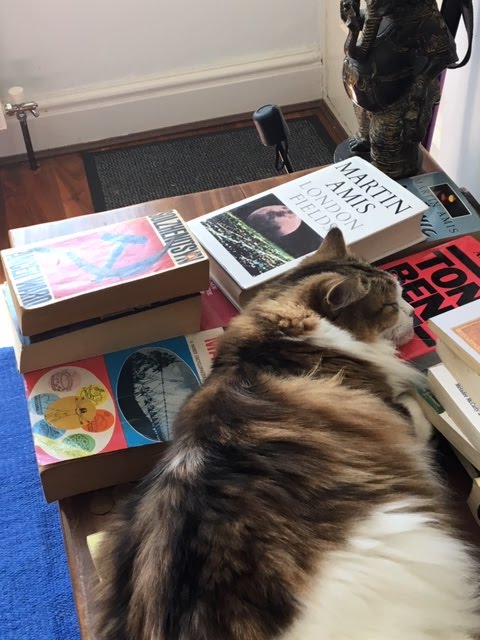
Boo boo in select company

Boo boo in select company
Something to say?

Wednesday, 9 July 2014

World War Two

My grand daughter Asha's school held a World War, Two day yesterday, for the grand parents. That stalwart group of men and women who bring their little charges to school and pick them up when parents are at work.

     Asha comes home at 3.30 pm and is ready for a meal. On her terms. There is a great deal of negotiation. Today the spinach went down after some protest, but yesterday was a fun day.

     At one , we oldies went to school. The children sang forties songs with gusto. I specially liked 'I'm gonna hang out the washing on the Seigfrid Line...'  They danced hip-hop and wore forties clothes. There were Wrens, old biddies with a scarf and curlers in their hair, military men...

     The event began with playing of a recording of Neville Chamberlain announcing the declaration of war. Evacuees' letters were read out by the children - some funny and some poignant.

     There was a dearth of Indians in the group. I remember; like it or not, it was my war as well, I thought. To begin with, my father, my only surviving parent, went off to jail because he was a devotee of Gandhi's Satyagraha. Non-violent or not, he was saying this was not his war. In August 1942, the Congress asked the British to quit India, and that was when the fun started.

     The Sisters at the Convent named and shamed me in class  as the daughter of a prisoner, a criminal. I protested vehemently and was locked in the dark, umbrella room, behind the stage where assemblies were held.

     I remember sugar and kerosene shortages and every one got only eight ounces of rice per day. The British Government was probably deciding on the ration according to their needs. Nobody told them us South Indians ate three huge rice meals a day. Wheat came to the rescue and we learned to make chappathis badly. To begin with they were the texture and taste of cardboard.

     The biggest joke was the ARP man whose job it was to secure the black-out, make sure the curtains were drawn and the lights dimmed. What curtains and what lights? We had neither of these encumbrances. So he got a 'glass' of tea with jaggery for his pains. In return he gave us the day's gossip.

     In my home, with Achan away, there was no money for school fees and we limped along from month to month. But, amazingly I knew enough to be very proud of my father. The community hung together helping us out with rice and sugar; 'He went to jail for all of us,' they said.

     It was a long two years before he came back and life returned to a new version of normal.

Sunday, 29 June 2014

Suarez Magic

I feel sorry for Suarez. All that talent and to miss most of the world cup. My family and I, we know him well, because we have been Liverpool supporters forever. This last Premier League season, Suarez was banned for the first nine games for another biting incident. But when he returned to the League, he was magic. He found the net every time someone gave him a ball.

Liverpool came second in the league this year and qualified for Champions' League, after many years. I see we are buying new strikers left, right and centre. (Though I think what we need is a defence now that we have lost our old faithful, Carragher, and we have Sturridge and Sterling around.)

But Suarez did not bite anyone after that ban just before the last season - until last week. I saw that bite and there is no way of  getting away from that. I saw the marks on Chiellini's shoulder. The teeth went in. But nine matches and four months? FIFA is making a point, or destroying his motivation?

That boy needs treatment, not punishment. I keep thinking of all the things we need to purge football of, before we home in on a Uruguayan with buck teeth.

No one would bite a sweaty footballer in the middle of a game, which millions are watching, unless there is a serious compulsion. Human beings do not bite as a matter of choice. And I do not believe Suarez goes out there with  intention.

How about the rampant spitting? We don't see Murray, Nadal or Sharapova, not even the courageous Williams  sisters spitting on the sanctified grass of Wimbledon, do we? But, in football, it seems to be de rigueur. What about all that head butting and tripping up ? Sometimes there is serious damage done to the victim. I have seen men being carried away with concussion or wounds on the face. Why doesn't FIFA punish for broken noses, for instance?

Racism is illegal, but they get away with racist rants and name-calling in many countries in Europe. Who do we ban for that? 

Then again, I think of all the suspected corruption that lingers in the corridors of FIFA. Nothing proven yet, but some strange things do happen.

'He who has a beam in his eye...

Friday, 27 June 2014

The Tory Landscape.

I must say I am bewildered. But then, I live in a permanent state of confusion recently: Must be old age and mishap.

Is Juncker going to be Cameron's Dunkirk? I wonder. What got into Cameron, sticking his thick neck out like that? Had all his advisers passed out, not to warn him to go gently into that political morass?

     Well - he'll be OK, I say to myself. The PRESS will analyse away his shortcomings and go looking for some fault in Milliband. In fact, it is a constant source of surprise to me, how our Press sacrifices truth so very often to save the Tories from their faux pas. In India people are losing faith in the Fifth Estate and its commitment to truth. Here in the UK that happened long ago.

   Even when Labour wins the odd by election, and the Tories are way behind, the Press can only comment on the shortcomings of Labour.

   Then there's the verdict on the hacking case, which went on for ever.  I never guessed Coulson managed that entire chicanery all by himself. How clever! He must be an organisational genius - why didn't we put him forward for EU Commissioner? Rebekah Brooks was declared completely innocent. But, of course.

   I taught in Beauchamps School, Wickford, where Andy Coulson also went, for many years - I wonder, did our paths, mine and Coulson's, cross? 

   Did the Wickford boy become the sacrificial lamb while the posh boys and women got clean away? I almost feel sad for Coulson. You can't mess with the class-lines, Andy, not even if one of them was a lover.

Saturday, 28 December 2013

Writing Dilemmas

Big question mark in my senile head: what kind of publicity is appropriate for my novels. Sometimes I admit, in moments of soul-searing clarity, that if they were good enough, they'd be up there with The GOD OF SMALL THINGS or PURPLE HIBISCUS, which must be two of my favourite books ever. There'd be journos sitting at my feet, drooling, as they did with Arundathi. (Mind you, at my time in life, just a publishing contract would have been good.)

I would like to think someone in publishing believes my writing is worth buying. But - I don't need the money. For the moment, I live with my children, who are bred in the Indian ways. They wouldn't dream of asking me for rent or costs.

   I have to wonder, though: should I do more about putting my novels in the public domain? The first one, A STREAK OF SANDALWOOD sells steadily on Amazon.com. Not enough to make me
rich or famous, but enough to feel someone is actually reading what I write.The second one, SHARDS OF SUNLIGHT gave me more pleasure in the writing, because it is sometimes dangerously close to my early life. It was painful and exhilarating at the same time. In the process I also cringed about the quality of my work in my first ham-fisted offering. I am still learning.

   So why do I write, anyway? Who cares if I do or I don't? Certainly not my children, though they say it keeps me out of their hair. Not Kitta, who is vaguely interested in my blogs, not Manju, who says my best writing is when I write about my life, and definitely not Raghu, who says it won't even pay for a month's beer.   

   I toss the thought around in my mind and I believe I write because I can construct something, which is totally mine, out of words in the English language. I love what words can do - persuade, deceive, influence, beguile, explain, admonish.... I can spend hours searching for that one word, which is right for the idea, give up, and find the word presenting itself gleefully at four in the morning.

   Then again, no one else has my take on my experiences, leave alone my particular ups and downs. So the process of writing is also one of taking stock, of admitting to things, of knowing me better.
   I don't think I'll ever stop.


Friday, 27 December 2013

S'Lone

This one is for all the S'Lone volunteers who made my life happy and wonderful in Makeni.  What a revelation Sierra Leone was to my naive brain!

This was in the period 1984 - '86 and I was a lecturer at Makeni Teachers' College, trying to train Maths lecturers and develop the Primary Maths Curriculum. I lived in a small, one-bedroom flat on the campus and it was an uncertain life.

Electricity was available rarely and water had to be carried upstairs to my third floor flat in a bucket, when it came, sporadically. Then, we all rushed and queued up - or pushed and shoved- to reach that trickle before it stopped. We learned the optimum height from which to pour a half-bowl of water into the toilet to clear it. Rosemary, a Canadian volunteer, taught me that.

Food was limited to what you could get locally. On the days the butcher slaughtered a cow, approximately once a fortnight, I waited on my small terrace to see him hang it up on a pole down the road. I would rush to get the fillets before the sun did the cooking. Fillets, of course, cost no more than other bits of beef.

The vegetable stall in the local market contained a few squashed-up tomatoes, half-onions, tiny okras well past their eat-by date... Nothing to take home. The Lebanese stores sold potatoes and you could buy cassava leaf and potato leaf anywhere. Corned beef and spam if you were lucky.You learned new tastes. And I lost two stones in weight.

The plassas was out of this world. Served with rice. I loved it. Sometimes I went down to the Shell station and ate it with the owner. You could also collect the local gossip: which musungu was sleeping with which black beauty, who was drunk at Pa Kargbo's veranda bar before eight in the evening...

The three-storey flats in which I lived was a self-contained community. Philip Kargbo's radio woke us all up at odd hours of the night and all of us ran down to see the cobra, which lived in the wood-pile behind my flat. Susan, who lived opposite, dumped her baby on me to look after when she had to go somewhere in a hurry and my friend, Fiona, the VSO who lived next door, made groundnut soup for me. It was delicious. She also taught me a great deal about Primary teaching.

Entertainment in a place sans TV or power was inventive. I played board games with Matt for match-sticks and rode pillion with the PCVs to unnamed places. I remember going skinny-dipping in a delightful, isolated, pond somewhere in the bush with one PCV. There was a waterfall and we had to push the tall grass aside with our hands to reach the pond on a motor-bike. We cooked and ate communally many-a-day, mainly cabbage soup and rice. Someone on a trip to Freetown would have brought a precious cabbage back.

Riding pillion was forbidden, but I got myself a helmet and risked being told off. HQ was so far away  and how would they communicate with us anyway?

One night a happy gang of PCVs woke me up at the two in the morning to see the forest fires. I tagged along. At 51, I was twice the age of most of them, but it did not seem to be an issue with those girls and boys. They were fun and non-judgemental in all matters. They always found new ways to have a good time.

The PCVs looked after me. They asked me along to fourth-of- July celebrations and spontaneous song sessions. They were talented and original. One designed a fish- breeding pond; several created prosthesis for children with damaged limbs. In Makeni they created swings and climbing frames for the children near by.

On the 25th anniversary celebrations they made me an honorary PCV. I was very proud that day.

I have been in other African countries since, living and doing similar work. More 'developed' some of them. But I have never been happier anywhere else. Now, at 78, I long to go back to SL and wonder how Makeni is now, how the College is and how , above all, my SL friends are.

What a country and what a people!

Sunday, 22 December 2013

Tiny Communities

There wasn't much of a choice. Our little world had to be small:

   There were about four buses a day plying between Kunnoor and Kuthuparamba. If they went further north - or south - none of us really comprehended such distances by bus. If you needed to go to Vadagara or Kanjyankadu, you thought hard and wondered how far the train would take you.

   To go to Maliyil house, which I sometimes did, with Damuettan directing proceedings (I bet he still does that, given half a chance), you had to do some serious planning. Bus? How much walking if you went by bus? Or train? Again, could we go the distance on foot?  

   In our house, our world was a microcosm containing just a few households. And we knew everything about them. The people even had the same names. We hadn't yet tapped that vast directory of north Indian names, all of which got amputated at the end. For instance Shankar, insteady of that nice dignified Shankaran. Sometimes it got to Sankarankutty too. Bliss!

   We had a Madhavi, and a Nani in our house. Next door, the two sisters were also called Madhavi and Nani. A few Ammus were scattered in the mix and a few Rohinis, mainly in the Thiya community.

   All of us had similar homes, some thatched, some partially tiled, others fully tiled like the rich Muslim houses near by. Mukkattil was such a house slowly decaying due to lack of care.

   None of the women had got beyond basic Malayalam literacy. So the only people with books were the lawyers on the road. They had impressive tomes called Law Books. In addition, my father actually brought home books to read for pleasure. To this day many of my friends in India are surprised at my library in Kochi.

   All the things we needed to buy were within walking distance at the turn of the road, near the Civil Courts. A dry goods man, who was also our neighbour, a tearoom owned by another neighbour, a tailor on our doorstep in a veranda room, a corner shop run by Mammadu for coconut oil or salt in a hurry.

   If someone got ill, the whole neighbourhood held their breath, while the native Vaidyar came and went. The 'doctors' were only called in-extremis. Children wandered around from house to house and adopted sisters and families. Mani, my cousin and I, adopted the house behind ours and all in it. They baby-sat, bathed us sometimes, took us to their temple and made jasmine garlands for our short hair.

   When my father was in jail, gifts turned up from many houses. Sugar, kerosene, sweet-meats; this was their way of showing solidarity.

   School was the limit of our world. A sparse world, but then all the houses were like that. There was nothing for display and nothing wasted. Even the beggars were local beggars; they knew when the mid-day meal was eaten in our houses and when alms would be distributed.

   Education as a given arrived with my generation and that was when the world expanded and we glimpsed imaginary lands.

This Brave New World

Recently I took the extreme step of surrendering my head and hair to a hair-dresser. Haven't done that in years.

   She worked on it for a long time, repeatedly saying, 'There is so much hair.' I felt I should tip her extra for the hair I had. 

   I insisted that she should not blow dry my hair. But, of-course, she was on auto-pilot and blow-dried my hair to hell and back. I emerged looking as though I had straw for hair. I went straight home, put olive oil on it, and washed it again. The hair stayed straw-like or a long time.

   So, one day, I says to my daughter. 'How do people with sparse hair get volume in it?' She said, 'Oh, there are creams and stuff. And they don't comb it to perdition like you do.'

   Of course. This is a definite trend of this decade. Very few women under sixty comb their hair. They are all promoting this sophisticated, disarranged look. Some succeed more than others ending up by looking merely untidy. When I see this I have a strong urge to find my bottle of coconut oil.

   Then there is the stance. Always slightly bent forward, head down, peering into a small screen of some sort. Soon they will discover a new 'app' (sounds like baby-food.) to straighten the necks of all ages and groups.

   In the sitting room the conversation has died. The concentration on the little screen is so complete, no one hears any one say anything. No one has time for conversation.

   Is thinking a casualty as well?

   In India there is much talk of the Aam Admi Party and the eradication of corruption. Now that's an ailment of long lineage and can withstand many aniti-biotics.

   Corruption is not restricted to politicians. What about contractors, engineers, judges, schools??? That little 'contribution' when you register a child in nursery school? What's the other name for it?

   I remember a group of defendants in a murder trial visiting my home at midnight. With one lakh rupees in bank notes in a small bag. I was ten years old. Their purpose was to persuade my father, who was then a Public Prosecutor, to go easy on the defendants. When he refused to collude with them, they threatened him. He was trembling with anger long after they left. I was scared for him.

   There was not much to get corrupted for then. Most houses had nothing beyond absolute need. We had no sofas, no wardrobes, no big mirrors... Achan shaved in a little mirror nailed to the pillar on the veranda. There was so little to buy in our reach that we did not think of it.

   I believe corruption is spawned and nurtured by the culture of too much to see and buy around you. I would love to go back to a more simple life. But then, I'd have to borrow a laptop. Mmm...

   I think the landscape has changed forever.