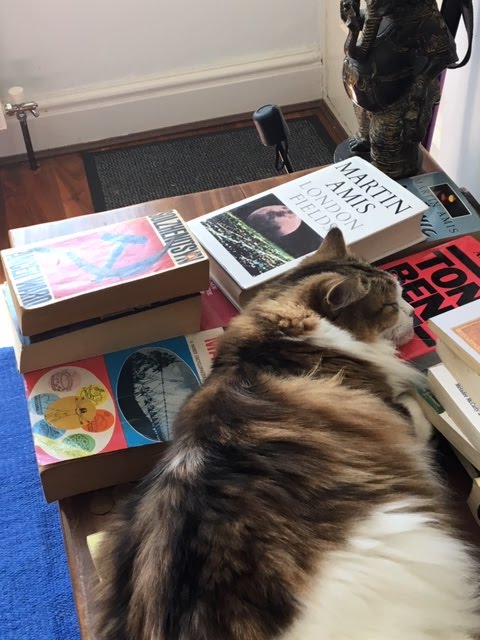
Boo boo in select company

Boo boo in select company
Something to say?

Monday, 21 September 2020

A Covid Morning

A Covid Morning

These Covid days don't linger; they fly past. What have I done with today?

   Made several teas, drank all. Ate my usual breakfast of two pikelets and a piece of apple pie. (yes, yes, I know. Very bad for ... ) Listened to the news and lies from BBC. Another cover-up being organized for Bo bloody Jo. Did he, did he not? Go on holiday last weekend, just when the country is supposed to stay at home. Did he go to Perugia? Why didn't he go further? My only chagrin -- if he went, and the airline insists that he did -- is that he came back.

   Listened to Beethoven's Ode to Joy on the streets of somewhere or other. The rendering was not great; I've heard better, but the people on the street joining in one by one, parents jigging around with infants, little boys getting a better view on top for the lamp post  -- made my day. So I parked it with my favourite tunes. I had to bribe my granddaughter to set that file and the Tracker up for me. I then listened to a Hindi song, 'Hame tumse pyaar kitnaa' sung by a talented duo from Kozhikode, then Eric Clapton and Paul and Ringo in 'Concert for George,'  with 'And my guitar gently weeps...' Decided to marry Eric Clapton, told my children. My daughter didn't bat an eyelid. She said he had a reputation for being a racist??? Where did she get that from? Raining on my tired parade as usual.

   Tried to bring up Moody Blues' Knights in White Satin, with no success.

   Ironed one solitary Hawai shirt for my son, put slug pellets on the Hostas. Then raked last week's grass cuttings on to the flower beds. My body announced it had had enough. So, shall now go to sleep, think, whatever comes my way. It is now lunch time.

   Chicken stir-fry for the evening if I can persuade my son to chop the thighs up for me. He has taken to wearing ear-phones - to avoid hearing me, my music? My daughter is in one of her perennial Zoom meetings, discussing the fate of justice in Somaliland. If it exists. Oxymoron?

   There you are. Exciting ?

Friday, 18 September 2020

THE THREE ABOMINATIONS

 The Three Abominations.

I think -- I don't know what India did to deserve Modi. But, of course I do. Same as I know why we have an unfeeling, blundering sociopath for our Prime Minister in Britain, and that destructive five-year old, Trump, in the U S. It's like giving a box of crayons and white walls to a child to play with. The people voted the monsters in.

   I was a teen-ager when the best minds of India, protested non-violently against discrimination in temples. Christians, for instance, were not allowed into temple premises at that time. My father was one of the protestors. They won and the temple was opened to all. It was a great victory for communities who believed in living together with grace and kindness.

   Interestingly, the people who protest most vociferously, about the harm Muslims do to India (define, please), are the ones who are quietly getting rich working in the gulf countries. What are the garbs that prejudice and racism wear?

   Growing up, our corner-shop in Thalassery was left of our front gates. It was owned by Moosa. At that time Muslims did not seek education and were generally employed in businesses. They were good at commerce. The richest men in Thalassery in those years were two Muslims who traded in timber.

   My aunt would call out to Moosa over our fence for paan and cooking oil and salt... Moosa would wrap the pan and salt in old newspaper and bring it around. The day Ammamma died he was on our veranda, through her dying agony, waiting with wet yes.

   In Thalassery, I walked to college daily with Mabel, my long-term friend, whom I still keep in touch with. I spent Christmas with her family every year, and she came round to ours for Onam.

   I attended a Catholic Secondary School and still know the prayers and responses. I am always thankful for that eclectic upbringing. It opened up my mind to the kaleidoscope of our lives.

   The gulf-crowd who worship 'Modiji' should hide their heads in shame. They have become rich on the tax-free incomes from Muslim countries. Our village, Kodiyeri, which used to be mainly thatched houses is now preening, with ugly concrete flat roofs and all mod-cons. They have money to spare. 

   Be grateful to the Muslims, who gave you jobs, and a way out of joblessness, which used to be the fate of the men, who passed out with 'empty' B As formerly, and had nowhere to go. I knew a few of them.

   I hope the next election in India will see our fake fakir, Modi, out.


Friday, 11 September 2020

Obedience is Bad, especially for Women


Obedience is Bad, especially for Women

 I think I was about three years old when I realised I had special status as a 'motherless child.') I was going to Madras (now called Chennai) to visit my maternal grandparents on that day in May, which I remember. My father told me to go next door and tell my echis (cousins, sisters) and ettans (brothers) there that I would be gone for a week or two. 

This is the house where I spent most of my waking hours. There were no children in that house and they spoiled me silly. Except Kannettan. He was a tailor, with a pedal Singer sewing machine parked on his veranda. He never smiled and would not let me go anywhere near his precious corner, full of multi-coloured bits and swirls of cloth, that I wanted to reach. But, on this day when I was leaving he went into his garden with me and plucked a perfect red rose for me. 'Poor motherless little one,' he said.

So motherless had its positives. Indeed, as far as I was concerned, it made no difference to me. My aunts and cousins loved me -- they combed my hair, dressed me for the day, wiped my tears when the kitten scratched me... Nani edatht always put a lot of love on to the semi-toothless comb when she did my hair.

However, our house was a little bare and naked compared to others I visited. Next door also had just the two chairs and the odd rickety bench. The women never sat on the chairs in either house. My Achan ate his meals at a small round table all his own, and the rest of us had palakaas -- low wooden stools. The food was served in tin plates on the floor.

My Velyamma hardly came to the veranda -- her domain was her kitchen. In houses with mothers, I noticed embroidered cushion cloths on the chairs sometimes. There would be a colourful hand-loom sheet occasionally on a bed. Next door, there was even a bunch of plastic flowers on a little table, on the veranda.

I had strict instructions from my father not to hang around in the kitchen, which I loved doing. Looking back, I think he was scared I would become like his sister and niece -- a denizen of the kitchen-world. So he set me work to do most days when I was at home. The long Malayalam poem, Karuna, by Kumaran Aashaan, was in four-line verses, and I had to memorise a verse a day. Tennyson's In Memoriam was another boring chore. I hated that one and have never looked kindly on Tennyson since.

I must admit the Eliza Doolittle role started early, with unforeseen consequences later on, when I started having my own ideas about what to think, how to live. At twenty-one I chafed at the bridle and gave my Achan enormous headaches. When he complained to a friend, the man said, 'But you told her not to be obedient.' This was true.

I remember my father going up the stairs one day while Velyamma complained I had been disobedient. 'Obedience is bad,' he retorted. 'Especially for women.'


Thursday, 10 September 2020


I thought Covid would make me write. The thoughts were going to be a deluge in my head and then they'd reach these pages to flood them. But, actually, I've dried up. So I have called me to the head-mistress's office and chastised me: delinquent in duty, lazy, non-stop commitment to T V...

So I promised the ogre that I would write two blogs a week to please her. She didn't really believe me. So much for my stupid, task-master alter-ego. Time to show her up.

My recent murmurings in my head are about the new India. In the families I know, birthdays are celebrated with profuse wishes, mainly on Facebook and the recipient says a bundled thank you at the end. This is a new custom. On my birthdays as a child, I received no 'wishes' or gifts. Velyamma insisted that I bathe BEFORE breakfast, do my devotions in front of the puja-room plaster images, and thereafter behave myself. That was a special responsibility: no lying, swearing, leaving food uneaten on the plate... Also, no one else should shout at me in the house and they should all do things for me. So the echis (cousins) plaited my hair, put pottu on my forehead, made rice-and-jaggery sweets for me. When I misbehaved, almost, Veiyamma warned echis that today was special and I should not be scolded.

These days, Facebook reminds me to wish 'friends.' I am obstinate that I will not be instructed in this manner by Crazebook. I am often sorely tempted to give up my Facebook membership, but that and Whats App are the only ways I can keep abreast of the busy lives of my friends and family -- marriages, births, deaths...

One or two girls in my class would bring a box of penny sweets or toffees to lessons  on their day and distribute them. They'd be wearing new clothes and you could see they felt important on that day. Achan had a very extended family to feed and educate and his going to jail for two years didn't help. One day, I moaned to him, and as usual he came up with a brilliant suggestion.

A suggestion I could have managed without -- at the end of the day, you must tell me what you did for someone else, he said. That is what makes a good birthday, he insisted.

Why couldn't he be like other girls' fathers? I thought.

.'

Saturday, 15 August 2020

That Dietary Supplement -- the Milk of Human Kindness.


That Dietary Supplement -- the Milk of Human Kindness.
 Last week's heat-wave was caused by the immigrants -- all those unwanted, homeless, supplicant people, coming to the United (???) kingdom in leaking boats. As if we don't have enough surplus-to-need blacks and browns coming here and flooding this place with doctors and nurses and such-like. And now, the thunderstorms -- they appear to have brought their murderous weather with them.
   Priti, our Home Secretary (made-for-the job) knows all about these people of course. She was one of them that came from East Africa, mostly Uganda, when Amin threw them out. So were Sunak's family. That cohort came by plane, with sterling bank accounts preceding them to smooth their way. They prospered here and now occupy positions of power. But Priti is adamant -- she wants none of them reaching here. And Rishi Sunak advises them that France is a much better place for them to be. 
  I was one of those too. I came in 1974, fleeing a bad marriage. The country was desperately short of Maths teachers at that time, and a job was available the week after I reached the U K. I spent ten years teaching in Comprehensive schools. On occasion, even the odd student objected to being taught by a wog. Accommodation was difficult to find and the only rooms I got were in the house of an Indian, taking a lodger.
   Eventually my children came, the eldest qualified as a lecturer of Maths, the second became a Structural Engineer, and the youngest a Governance adviser with the British Council.  We did not need any benefits ever and were warmed by the kindness of the ordinary British person.The odd racist asked me to go back to where I came from, my children suffered nicknames ---- It didn't disturb our sanity.
   All four of us were acutely aware of the glass ceilings within our professions then. That invisible top is still there. We accepted that as par for the course, grumbling a little now and then.
   Are we not a compassionate people here? I ask myself in 2020. The 4000+ immigrants in a year, desperate people who come here in suicidal conditions can surely be accepted with care and kindness. We have big enough hearts for that, don't we? I hope Priti and Sunak will look hard at themselves and do another U-turn. The Tories have done so many, they must be pretty (Priti?) good at it by now.

   And, of course, our economic collapse was definitely the fault of the immigrants-- it is beginning to sweep us into recession, and the Government will need someone to hang that one on. Immigrants? Who else?

Friday, 31 July 2020

My Threadbare Home

I rarely offer to empty the dishwasher as it requires bending and straightening up many times. There is no space in the cutlery drawer for all the armaments we accumulated over the last decade — it wasn’t too bad before that. Around 2007, my daughter returned to England from Kenya and I from India, bringing with us our households. So three households were now crammed into the small bachelor home of my long-suffering son. In the end, he bought a larger house, just to accommodate his unwieldy family.

When the spoons and forks spill over into the drawer, I remember our home in Thalassery. We had one metal spoon in the house, which was my father’s for use with his evening conjee. The rest of us had spoons made from the leaves of the Jack fruit tree. This was an adhoc arrangement. When conjee was served, one of us children would be instructed to pick a few jack leaves. This was no off-hand chore. The leaves had to be fresh but not too soft — they shouldn’t disintegrate in the hot conjee.  And they had to be shaped and held together by a piece of eerkili (spine of the palm leaf). I was never great at these feminine skills.

Once, my visiting aunt got so disgusted with my ineptitude, she asked me to go back to the jack tree and fetch better leaves. I had enough by then. I gave her my father’s precious spoon.

‘That thing that is sucked by all and sundry?’ she asked contemptuously. ‘I’d rather go hungry.’

This happy spoon-less state of affairs continued till I got married and went to Colombo to live with my in-laws. They were of a different ilk; I would call it faux-western. Proper china and a plenitude of spoons and forks and knives, not to mention sofas and sprung beds, and curtains in the windows. When I went home to India to have my first baby, I felt as though I could breathe again. I packed away my tooth brush and Colgate tooth-paste, and happily went back to an earlier oral hygiene — burnt husk on my index finger.

My husband threatened to visit after a few months. Now I would need to pander to a different food-protocol. He ate rice like the urban Ceylonese — with fork and spoon, the fork in the left hand, pushing food into the spoon in the right hand. And we,in Thalassery, had no forks or knives or spoons. The gofer was sent into town to bring back two spoons and two forks. He returned empty-handed. So I went hunting and unearthed some cutlery in a disused drawer in a small shop at the bus-stand.

‘From the time of the White Saives’ the shopkeeper said. ‘Who is this for, now?’ Emphasis on the NOW. I refrained from answering. The deal seemed almost a betrayal.

How far have the mighty fallen! My father grinned with great amusement, when I went home with my finds.

‘What are you going to do about the dry latrines?’ he asked. But that, as they say, is a whole other story.


My Alter Ego

My alter ego from Keralam

This is a blog about my very Indian other self. Actually Malayalee, (from Keralam, speaking  the local language, Malayalam) because I probably have less in common with people of some of the northern parts of India than with crazy Croydon, where I have lived  since the late nineties, with occasional forays into Keralam to recharge my other self.  I started this site in 2013 and never pursued it. But now, senility combined with Covid Lock-down,  and the remorseless tick-tock (Rushdie style) of seconds, minutes, hours, days… persuade me that I must get this going, if my granddaughter is to have any idea about her fractured beginnings.

At fifteen years, she has a room and bathroom of her own, you enter there at your peril — unless your sneak in to pick up the daily debris, while she sleeps the sleep of the innocent. In our house in Thalassery, in the north of Keralam, I ponder, five of us females, aged between seven and fifty-five, slept in the puja room. Ammamma, the eldest had a narrow bed, the rest slept on mats spread on the floor. It was a small room; when the mats were rolled out, there was no walking room, so you stepped over the others if you needed to get out. I did not qualify for a pillow at my age, graduating to one only on my wedding night. I wonder what my new, just unpacked husband thought when he found his wife constantly slipping down a notch, in the bed, to escape the pillow. It didn’t help that some kind souls had covered the nuptial bed in jasmine petals. JESUS WEPT!

Men were considered superior to us; they slept upstairs on beds and mattresses. Indeed, but for the beds upstairs, the house was mercifully devoid of furniture. My father had two chairs in his office in the corner of the veranda. His clients sat on a bench, which was not trustworthy, as it had uneven legs and tended to go up at one end, when a weight came down on the other. My father also had a big table and a Dutch glass-fronted almirah. The almirah contained his law books, with The Indian Penal Code occupying pride of place. He was a lawyer.

We had a Planter’s chair too on the veranda, on which I used to curl up and sleep, waiting for my father to pick me up and carry me up to bed, when I was still little. It was a lovely object, that chair, until you got close to it. Most of the wickerwork had torn off on the seat and you had to stick to one little Strip, which had a few strands left. And look out for those sharp bits of unravelled cane sticking out!

For the rest, we sat on palakas and thadukkus , wooden stools and small grass-mats. These days, when I visit India, I see no stools or mats to sit on. The middle classes sit on sofas, while the poorer families sit on basic wooden chairs. Just as well considering the shape of my knees