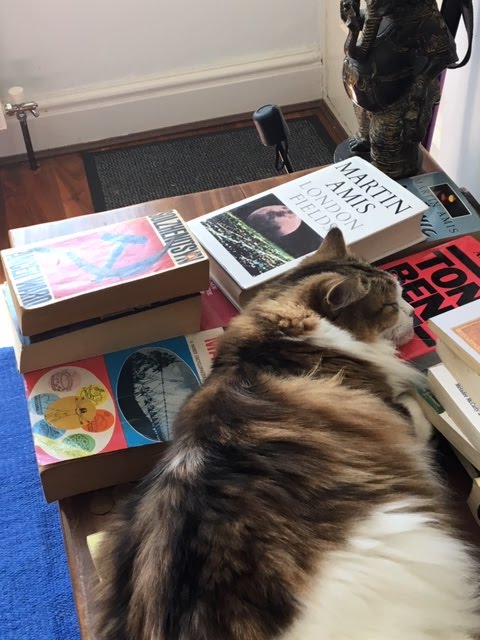
Boo boo in select company

Boo boo in select company
Something to say?

Friday, 26 December 2014

The Police at their very Best!

Another excerpt from SHARDS OF SUNLIGHT


The Police arrive. I am terrified:


Next week, Indu woke up on Monday morning with a sense of momentous events, larger than herself, larger than any one person, looming. Instead of her slow, dopey shuffle around the house and compound, she skipped and ran around making Shinnu ask, ‘Why are you acting like a kitten before a storm – lifting your fluffed up tail and darting about?’
   As she walked through to the kitchen Indu could hear the excited chatter of the milk boy as Shinnu held out the lotta for the day’s milk.
   Kodathi, she heard, and pathaka.  The Courts and the flag. She went to the back door to listen.
   ‘Enthada?’ What is it, boy? ‘Noise and chatter when people are still sleeping,’ Devi said to the boy.
   ‘Devi ammey, kettilley.’ Haven’t you heard?
   ‘Heard what?’ Devi sounded offhand.
   ‘The Court grounds are crawling with policemen. Even the beach in front is crowded with people watching. Can you believe it? The flag flying on top of the building is ours.’ The ‘ours’ had a jubilant, almost uxorious ring to it.
   The boy was pouring milk into the lotta, looking up at the women as he talked, and the milk overflowed from the top of the brass pot.
   ‘Look at the milk,’ Shinnu shouted.
   The boy sobered up and tried to wipe the side of the lotta with a piece of multi-purpose rag that adorned his neck as a sweat band; normally he carried it on the seat of his bicycle to cushion his bony buttocks. Shinnu pulled the milk-pot away in disgust.
   As the boy went to the gate, Vijayan  (neighbour and activist) scurried in. ‘The police are on their way,’ he said to Devi and sprinted off breathlessly. ‘Don’t want to be seen here. Keep the door to Ammini Amma’s room closed.’
   He reached the gate, stopped a moment and rushed back breathlessly. His sleek, pomaded hair was dishevelled for once. ‘Don’t let them go too quickly from here.’
   ‘That’s great,’ Devi started sarcastically, but Vijayan had already disappeared.
   Indu and Mani ran to the gate to have a look.
  Marching down the Court Road, the police, they saw, had gathered a tail of urchins. The neighbours spilled out to the edge of their compounds, pretending to look at the coconut trees, hang out clothes on the line, beat the door mats on the veranda steps… Anything to join the mela. The Inspector leading the group of policemen opened Indu’s front gate and the men filed through. The last policeman shooed away the boys. ‘Poda,’ he said almost in a whisper, go. He raised his lathi, his swagger stick, in threat and the boys hung back for a moment, feigning fear. As soon as he turned away they came closer, whispering to each other.
   Devi saw them coming but went inside. Her thin joyless lips were set into an even thinner line and she pulled her top-cloth over her shoulders. She intoned a few quick ramaramaramas under her breath. Indu knew all about those ramaramas. Devi needed her God because the problems were beyond her.
   ‘Shinnu,’ Devi called out as she walked to the door, ‘Don’t come to the veranda.’
   The two girls, Indu and Mani, had followed the policemen to the veranda but escaped Devi’s X-ray eyes. When Devi came out, the policemen were gathering in an uneasy group on the steps of the veranda, with the Inspector on the top step. Devi watched impassively.
   ‘Entha?’ she asked as though policemen on the doorstep were a daily event. What is it?
   The Inspector took his time answering. Indu could not decide whether it was embarrassment that made him hesitate, or pompousness. Maybe he is waiting for Devi to be afraid, she thought.
   ‘We need to search the house,’ he said.
   ‘What for?’
   The Inspector clearly did not know what he was looking for. ‘Search means looking for anything, everything. Move aside from the doorway.’
   Devi was blocking the doorway, but she didn’t move. The man took a step forward. Indu got a little closer to Mani.
   ‘Mani,’ she whispered.
   Mani clutched Indu’s hand tight in hers.
   The policeman made as if to push Devi away to enter inside, but Devi stood her ground, staring at him, as though challenging him.
   ‘Stop there,’ a breathless voice commanded from behind the police. ‘Have you got a search warrant?’
   It was Damu, from down the lane. He was wearing only a dothi and a vest and must have sprinted down the road. The dothi was doubled up and tucked into his waist for running.
   ‘I don’t need a search warrant. These are special times.’
   ‘Yes, yes. Special time indeed when policemen can come and threaten women in houses where there are no men. Shameless lot. Go find some men to frighten.’
   The Inspector took a step back from the doorway.
   The lawyer turned to Devi. ‘Don’t open the door to anyone without letting me know. Search indeed!’
   The Inspector stood back for a moment and then signalled to his entourage. They filed out of the veranda in an untidy group as the urchins turned round and giggled at them.
   Devi breathed a sigh of relief; Indu and Mani followed her inside. Her courage lasted only till she reached the kitchen; there she collapsed in an untidy heap and started trembling.

   ‘Keep that scum here indeed. What did Vijayan think I was going to do?’

Tuesday, 23 December 2014

The Quality of the Day.

Yesterday I thought about Kampala. It was the quality of light here in Croydon on a bright winter's day that reminded me of the time I spent in my garden on the Kyambogo campus in the late eighties. I didn't have to do much; there was my gardener, Sam, to do all the digging and the planting. Sam, who died before he got to twenty years, like a great many Ugandans who did not know about AIDS, and believed what their culture said - that it was essential to sleep with many women as soon as possible after initiation to test out the skills learned at the boot camp.

   Sam was one of the world's innocents, fiercely loyal to the garden and me, in that order. He did not know a word of English when he came to me, but was fluent by the time I left.

   It was a huge garden, a half-acre of the kind of Kampala land on which you could stick a twig and it sprouted leaves, and just cutting the grass took forever. There we grew elephant grass or paspalam, which grows sideways and does not have to be cut too often. It is sturdy and does not get diseased like the more precious Mexican grass, a real prima-donna, that most people have on their lawns in India. In England it is an egalitarian mixture of weeds and grass of all kinds that I disguise as a lawn by keeping it short. I don't have a Sam around to keep my lawn primped in Purley.

   If you got up early in the morning after a rainy night on the campus, there was this translucent quality to the light. There are no words to describe it. You felt like staying in the garden forever forsaking house and work and everything else; it was other-worldly as though the benediction in the morning made everything right with your world - even when the pipes ran out of water, the power blinked off and the neighbour's dog had put down its morning offering in front of your gate.

   I considered it a pity I had to go to work on those days. But I came back at break for coffee, at lunch time, and early in the evening after lectures finished. All those times I wandered happily in my garden, sometimes with my dogs Leone and Makeni named after Sierra Leone and Makeni, a small town up North, where I taught from '83-'86. I took my dogs for a romp in the Secondary School grounds that were also situated on our campus. In the evenings it would be deserted and peaceful.

   Grace, my cook and general factotum, would have cooked my evening meal - all Indian food that she learned to do better than me. She also died of AIDS soon after I left. When I look back, so many of the people who were part of my life: the English Lecturer who planned a play with me, my Head of Department, that lovely man, David Nyakairu. my colleague Helen Akwanga... and five or six from my Maths class each year.


   They simply did not know.

   Then again, there was the other Kampala: looting and and killing ten minutes walk away from the campus on Jinja Road, the famous Jinja (an hour's drive away) where the Nile begins its long journey to the sea far away to the North. 

   Of all that, in my next blog. Africa beckons as it does now and then.


Wednesday, 17 December 2014

My Father Gets Arrested


My father gets arrested

They came for Gopalan, Indu’s father, a few days later. The police jeep arrived early in the morning as the maids turned up to sweep the front yards and draw water for the kitchens of the middle-class houses on the road. On that morning the roads were quiet except for the bicycle bell of the milkman and the creaks of the wheels of the shit carts.
   The two policemen in the jeep were in mufti, and looked left and right furtively as they closed the doors of the jeep. They walked towards the house, throwing away their half-smoked beedies.
   Gopalan, sleepless and weary, and Indu, saw them from the upstairs window and was ready for them, but when they took the handcuffs out, he blanched.
   The policemen looked at each other, then at Gopalan’s bony wrists and his sparse body.
‘See, my bag is packed and I am going with you,’ Gopalan said. His voice trembled a little on the last phrase.
   ‘It’s not you we are worried about,’ they said, but they put the handcuffs away.
   Gopalan picked up his suitcase and went down the stairs in front of the men.
   At the foot of the stairs was his mother’s room; he stooped under the low wooden lintel of the door. He had not thought of the words for this moment, he who had words for all occasions.
   ‘Ammey, I'm going,’ he said.
   She was curled up on her bed in her dark cave of a room and he could just see her white face and the rough grey blanket pulled up to her shoulders. The room smelled faintly of the ripe bananas and rice for the household stored under her bed, and her medicines.
   Ammini struggled up and let her legs dangle over the side of the bed. As she did so she took in the two men standing grimly behind him.
   ‘Who are they? And where are you going?’
   Gopalan put his case down and bent to touch her feet for her blessing, but she turned away from him and lay down again on her bed, turning her face to the wall.
   ‘Ammey,’ he pleaded, but she did not move.
   Devi and Shinnu came out of the kitchen with Mani and looked at the scene in front of Ammini’s doorway.  They clutched each other, and the two girls stared, terrified.
   'Time to go,’Gopalan said looking at Devi's frantic face. ‘Don’t upset the children.’ He picked up his suitcase again.
   ‘No,’ Indu screamed as she hurled herself on her father, sobbing. ‘No-o-o. Tell them to go away, Acha, tell them.’
   Mani ran to him then. ‘Elayacha. If you go…‘  She was sobbing too.
   Gopalan bent down and gathered the girls in his arms.
   ‘Listen, Mani. You've got to look after both of you. And help Devi Ammamma. You mustn't cry. They’ll all start crying and what will I do then?’
   The two men stared woodenly as Gopalan turned to leave. They followed him out of the house and through the front gate. When they reached the jeep they bundled him into the back and got clumsily into the front, hurrying to get away. 
   As the car started, it became apparent why they had come so early and silently: a small crowd of men and boys walked towards the car. They looked belligerent and some of them had stones or sticks in their hands.
   As the first stone hit the windscreen, the policeman at the wheel  revved up the engine and accelerated away.
   Indu and Mani ran to the gate.
   ‘Come inside,’ Devi called out, but there was too much noise and excitement and the girls pretended they had not heard. After the car drove away and the crowd dispersed they stood at the gate, watching the few loiterers.
   ‘When will Elayachan come back?’ Mani asked. She seemed more disturbed than Indu, who had not quite understood that this was an arrest, and her father was going to jail.
   ‘In the evening,’ Indu answered, a little contemptuously. Achan always came back in the evening. Mani started crying. Indu watched perplexed as this was a truly unusual thing, Mani normally bit her lip and shut her eyes tight against the world when she was upset, but refused to be seen crying.
   Mani picked up Indu’s hand and started walking towards the house. She did this also rarely; she was not given to demonstrations of affection.
   When Achan did not come back in the evening, Indu slept in Devi’s bed.
   ‘Ammammey, wake me up when Achan comes,’ she said to Devi. Both girls called her ‘Ammamma’ – mother’s mother, as though to compensate for the fact that she was childless.

   ‘Yes, soon as he comes,’ Devi murmured, and for once she put her arms round the child and drew her close.

Thursday, 11 December 2014

Morning Rituals from Shards of Sunlight

From Shards of Sunlight.  Morning Rituals


The list: nobody would tell Indu what this list was. Since Ahmed’s visit the women in the kitchen talked about nothing else. That and something called Swaraj. What was that?
‘What is this list, Ammammey?’ Indu asked in her deliberately winsome voice the next morning, when Devi was performing her dawn ritual of lighting the devotional lamp. Sometimes an answer slipped out by mistake. ‘Is it like the list you make when the dhobi comes?’
            Devi didn’t answer; she rarely had time for Indu’s many questions. She muttered prayers under her breath and pulled out the crumpled newspaper pushed into the neck of the coconut oil bottle in the puja corner. She sniffed at it. Then she tore up a piece of old mundu for wicks, and twisted three-inch strips to make points to light. She placed the wicks in the saucer of the lamp to soak and drew one end of each towards her.
            The bit Indu loved came next. Devi pulled out the usually damp matchbox she kept behind the plaster Krishnan’s shoulder and started her battle with the matchsticks. Three fizzled out before she got a flame on the fourth, and the room filled with the familiar dawn smell of sulphur and coconut oil. When Indu had got her fill of that comforting smell she went out to sit in her favourite place on the veranda edge, carrying the dawn benediction with her.  The sunbeams splintered into rainbow colours on the cracked cement floor. She put her hand over them and imagined she had caught the colours of the morning.
Devi came out a few minutes later with her pan box; this would be a good time to ask questions, Indu knew. Devi was always amiable when she was chewing pan.
‘What’s Swaraj, Ammammey?’ Indu asked. She smelled the green betel leaf smell and the sharp tang of chunamb, the white lime paste, which Devi put in minute quantities on the leaf, as she chewed.
‘Oh. It’s like – self-government.’ Devi said.

Just like adults. You ask them for the meaning of a short word and they give you a longer one. Indu gave up.

Book Signing at W H Smith, Croydon.

I must admit I am not confident about these events, but feel I am letting myself down if I don't go through the promotion processes. Strangely enough, once I get to my seat, behind that table, stacked with new-smelling copies of my most recent offering, I am full of enthusiasm and ready to go. This was the case again last Saturday.

   The manager at W H Smith, Whitgift Centre, Croydon, was incredibly helpful and kind. So was his assistant, Sara. To begin with, I didn't expect to even gain access to him. The last time, three years ago, with my first novel, I had to practically door-step to get to the assistant. I never saw the manager. I met instead a beautiful, young woman, called Ama who looked after me. She died last week, I am told, unexpectedly' and no one knows why. The unpredictability of human existence! I think of what her family must go through for a long time from now and have no words to make it easier. It cannot be made easier.

   This time, there was this wonderfully kind man, Nick, the manager, who had time to talk about book sales and indeed taught me a great deal about the process. He made it all sound simple. Sara organised the 'table, got posters up, pointed to essentials like loos and offered to help if I needed anything. I think I would have been happy even if not a single book got sold.

   I carried my flask of tepid tea and my cheese and ham sandwiches. A friend rushed off and got me a bottle of water. My daughter had already taken the books in on Thursday. I was ready to roll. My friend Tommaso was ready with his camera to take the photos, like the ones in this blog.

   'Are you good at talking to the people who come by?' the manager asked. If I wasn't up to  it then, I was going to be now. I thought of all the African countries I had worked in and all the tight situations, travelling, I had to get out of, (like the time, British Airways dumped a whole plane load of people like me in Banjoul, refusing to go further because airport fees had not been paid. I had to sweet talk the local porters to load my luggage into the small planes provided to ferry us to Freetown, where all of us were going.')

   So when the punters walked by and slowed down past me, I smiled my best smile, and gave them the spiel. Occasionally, when I saw someone who could not afford the money right then, I felt like giving them the book, with a hug. But I was not in charge of the buying and selling and let it go. 

   My daughter had taken thirty books in and twenty-six went that day. Smith offered to display my book on their shelves - what more could I ask? Last time I sold four, and three were bought by my son's friend, Jerry, bless him.

   My friends - my son's friends - bought many for Christmas presents. I suspect a Bulgarian and an Italian friend will have to search hard to find people to give them to, who actually read English fiction out of choice. Ah - well.

   Makes me think: I shall start my next book in earnest today. Seems worth while. I am thinking well. Thank you all - book-buyers, W H Smith, Raghu's friends, family. What a day! 


Sunday, 30 November 2014

Cobra Land

Freetown is one of three cities in the world where cobras are endemic. I didn't know that until the British Council sent me a wad of familiarisation documents, before my first trip to Sierra Leone in 1983.

   The documents were amazing: they told me, among other things, how I should boil my salad before eating it to avoid stomach diseases and not buy food from the open markets. In Makeni where I lived there was no food sold anywhere else.They also urged me to attend an induction event at a manor house in Berkshire to learn about living in the tropics. In spite of the fact that my CV clearly said I was born and bred in South India. And yes, I should buy a hat; I would need one at garden parties when royalty came to visit. Garden party? I had never met one of those animals before and hoped to avoid them forever.

   I had not a seen a single wild cobra in India in the twenty-three years I lived there. The snake charmer occasionally brought some doped-up cobras around, which danced to his pipe. They looked harmless; my father said that the poison fangs had probably been removed.

   In Freetown, however, cobras were common - part of the landscape. My very first morning in Freetown, I drove to work to the Ministry of Education, at eight in the morning, feeling my way into the centre of town.The road descended from a hill-side rapidly into a cleft of land where the town nestled. The road to the Ministry was a mud-red ribbon which wound round the depression in the ground, with clusters of government buildings, in large compounds, on one side.

   Just before I reached the entrance to the Ministry, I saw a huge black rope stretched across the road. Lorries hooted over it and passed without stopping. It was only when I was nearly upon it that I noticed it was a huge cobra, squashed to brown-and-red pulp in the middle, and the rest of it intact. Thankfully, quite dead. Later, my colleague at the Ministry dismissed the event lightly. 'They come up from the low ground near the ocean,' he remarked. 'So much new building in that area.'

   In Makeni, in the North, where I lived from 1983-1985, there was a resident presence behind our flats. The women would see it sometimes near the outside cook-house when they worked there. Once, it was seen in the brick oven and no one would cook there for some time. 

   Things got interesting when a pet monkey tethered to a tree behind our flats died from snake bite. The men decided to take notice. One day they saw it crawl back into the brick oven. Two of them quickly made a fire from dry leaves. They waited outside until the poor snake came crawling out and beat it to death.

   It wasn't until 1985, when I moved back to Freetown that cobras lifted their hood again. One got inside our Assistant Directors air-conditioner and his wife came running to my house next door, with the baby. She was crying. 'Can't take any more of this,' she wailed. A few minutes later, Kaba, my young gardener, walked in to show me his trophy. A three foot, very thin cobra hanging dead on a twig. He was very amused at the crying white woman.

   She gave him ten Leones for his troubles. 'Where was the husband, Kaba?' I asked, after she left. 'Running around taking photos,' he said. He must have thought all of us Mzungus (foreigners) quite mad. My worry was that Kaba would soon begin to find little cobras to put in our AD's house to get more ten Leones.

   Kaba himself got attacked in my garden one day by a spitting cobra. He could not open one eye for a while, and I washed the eye with coconut milk as they did in India. I hoped he would not be tempted to go near them for a while. At least till I left the country.

Thursday, 27 November 2014

Sierra Leone revisited

Sierra Leone’s present plight occupies my mind. You might ask, what about Guinea and Liberia? Well, Liberia is pretty much over the worst, and Guinea claims that the Ebola virus is not spreading, though information appears hard to come by. The fact is, I did not live for five-and-a-half years in Guinea or Liberia. I don't know any Liberian and the only citizen I know from Guinea lives in the United Kingdom.
   I started this blog account (Other Lands and Other People) when it occurred to me that many people from Britain know little about how people in Asia or Africa live. Apart, that is, from the bright spots like Thailand or Singapore. South America has become more familiar with some tourist spots becoming famous in that part of the world. But,Congo? Mozambique? I bet very few people in Britain know what those countries look like, how the people live, and what, in human behaviour, is taken to be the norm.
    Sierra Leoneans live with every-day deprivation that we could not dream about. A great part of Africa does. When I finished my fifteen years sojourn in various parts of Africa and returned to the UK, my first thought was, thank God for running water and absence of cerebral malaria.
    I had come up against both: in the Northern part of Sierra Leone, in 1986, I became ill without knowing what was wrong. My head and neck hurt a little all the time and my energy levels fell. My job required running around all over Sierra Leone like a mad monkey. I came to the UK at about that time on leave and became seriously ill with fever, vomiting and diarrhoea.
    The local GP in Basildon came around to my house (I was bed-ridden by then) and said he would do some tests. The test results took forever to come; in between he would not prescribe anything. I kept pleading with him to treat me for Malaria, but he could not see any evidence of it even in the blood. When I started rigours as in Malaria, he ordered another blood test, and I knew I would die if he did not give me medication soon. The second blood test showed I had cerebral malaria and I was carted off to the Billericay hospital, where I was isolated, in spite of my telling the doctors and nurses there, that Malaria could not spread without the mosquito.
   I remember the consultant from the School of Tropical Diseases who came to discharge me; he opened a small bound booklet and started searching for information on Malaria. This did not actually encourage my faith in him. So I said to him, 'The flukes live in the liver for a while. I need medication for three weeks to stop them from making me ill again.' He looked again in the book and prescribed another medicine. In Sierra Leone, many people live with Malaria until they die.
   Malaria kills a great number of people in some countries. More than Ebola, but it does not spread from person to person. I am sure malnutrition kills just as many. Infant mortality rates are high and the death of a child in small, remote communities is commonplace.
   The pharmaceutical companies did not get interested in producing a vaccine for Ebola until recently. When the WHO started making dollar signs. The question: do people from other countries have a moral obligation to actively promote health and the eradication of disease in other countries, even when we are not under threat?