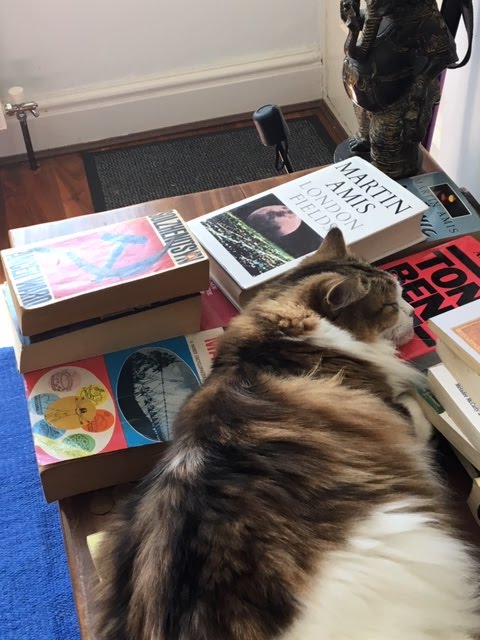
Boo boo in select company

Boo boo in select company
Something to say?

Friday, 8 March 2013

The Numilis

I came across the numilis two days ago when I was rearranging books on the shelf above my work-desk. They have been book-ends for a long time.They are quite ugly, these two little statuettes crudely made of soap stone. 

The big one, about nine inches high has a face more distorted than the small one. It is a he - the features are all merged into each other as though he has recently been cured of leprosy. The head is most of the statue, with the body a short stump below it.

The smaller one is darker, slightly more personable. Looks like she had crude plastic surgery , though, and the doctor gave up half way. She sneers a bit.

I collected them in a very different life in Sierra Leone. I didn't know what they were meant to be, but then Sierra Leone was a bit like that. You had to take it on trust and most times that worked. (But not the time when we had a shortage of diesel in the country and I stored a fifty- gallon drum of this precious fuel in a Lebanese friend's warehouse. I lost both petrol and friend.) Some you lose.

The numilis have something compulsive about them in their utter misshapenness. You end up looking at them for a long while. Malcolm Thompson, our Assistant Director of the British Council in Freetown, had a collection of these in his office and it was he who told me about them: Sierra Leonean women kept them under their marital bed because they were fertility symbols.

'What happened when they failed to conceive?' I asked. 'Oh, they smashed them up and threw them out of the front door,' my boss, Mike Chadwick offered. And I knew I would like those women immensely.

All this came up in my memory during the International Women's day snippets on the TV. We heard a lot about how badly the women in England got discriminated against, in the workplace. True, very true. But, does it compare even remotely with what happens in Asia, and to a larger degree in Africa?

In some African countries, women deliberately had children before marriage so that their fertility could be proved beyond doubt. Even though they had no means of supporting them. In a country where multiple partners was the norm, where would an infertile spouse stand in the hierarchy?

In the North of Uganda, after the boys were 'initiated', I was told they were advised to have sex as soon as possible after the event. The boys would be anything between four and fourteen years old. My gardener had AIDS by the time he was twenty and he was dead before twenty-five. These boys who were sent out to go forth and perform, I wonder what age the girls were that they practised on.

I once went to a Vodoo shrine near Gbendembu in Sierra Leone. It was hidden well inside the forest and there was no path to it. There was no way you would find it if you didn't know it was there. A Peace Corps friend extracted the information about this voodoo shrine from a local friend of his, who had to remain unnamed. We went there on a motor bike - I remember being hugely disappointed. A low thatch made of mud. What was there to look at?

Returning to Makeni, we saw a group of boys being led on the main road, by two men. The men had bamboo canes in their hand, which they used to keep the lines under control. The youngest looked under five and the oldest no more than ten or eleven. My friend stopped the motor bike and took his camera out. He clicked furiously. When the vodooo leaders noticed him they ran towards us, my companion powered up his bike, accelerated and got away quickly.

The friend who told the American about the shrine was a Catholic. 'Thank God,' I said to my friend. 'So, at least, his daughter is not going to get mutiliated.'

My friend smiled. 'I think he will hedge his bets. There is a lot of pressure on him to conform.' So the ten - year old was at the mercy of the elders in her community. Or the strength of her father's resolve.

I find it quite hard to get incensed about the women who don't reach the board rooms in the United Kingdom. Totally unfair, I agree, but if it's women of the world we are talking about, my sympathies are engaged elsewhere.

Saturday, 9 February 2013

Modi for PM? Surely Not

Narendra Modi scares the life out of me. Some unthinking ignoramus recently compared him to Nehru in all but words. Now, Here's where I jump into action: Hands off Nehru, you sectarian cowards. You are talking about the man who had the vision of India as a secular country firmly fixed in his heart. And you dare compare Modi, with his history, to Nehru?

And now the EU is cosying up to Modi. All those horrendous deaths in Gujerat can be wiped out from our collective memories by someone saying it was a mistake?? Won't the West ever have a conscience where their investment interests are concerned? Shame on you, E U. Please go away and put your own house in order. Ours is a mess at the moment and we are searching for a way to that light  we used to have at the centre of our hearts. It's there. We'll find it in spite of our Nethas.

Having grown up in Thalassery, this sorry Hindu-Muslim non-question is beyond me. In Court Road, the centre of my child-universe, I was surrounded by large, ancient Muslim homes. They were not particularly wealthy and the little ones my age were my friends. The compounds were uncared for, slowly receding into decay.

To begin with Aliyumma did not wear a thattam. She went on errands for her family to the local corner shop and we talked to each other in front of my house. I would see her with a half- bottle of coconut oil with a paper cork. I think there was no money to buy a whole bottle. I don't think we got to a full bottle very often either.Some times Aliyumma came to the house behind mine to play.

The corner shop belonged to mammad, also a muslim. We hated him because he told on us to my father, about all our mischief on the road. We were not supposed to get on that road, where the Kunnoor bus hurtled past seemingly without brakes.

When I was around ten I noticed that Aliyumma had gained a cloth on her head. It wasn't much - just a thin long muslin cloth wound round the head twice and tucked into place. When she ran around it flowed behind her.

She was breath-takingly beautiful. So was her brother, mother, her entire family. I marvelled at their complexions, more Persian than Indian.

Soon Aliyumma disappeared totally behind that thattam. She stopped coming to the shop or to play. She must have been twelve then. Education had never been a big thing with the Muslims in our neighbourhood, not even for boys. 

Soon her Nikka was arranged. Before the ceremony I went to visit her ara - the room in which she would meet her husband. Later still, she showed me her collection of crockery and perfume bottles (attar, she called them) displayed on the shelves, gifts from her husband's family. I had a sense of disconnection. I was learning Wordsworth and Algebra and she was learning to be a Muslim woman.

On one of my recent visits to Thalassery I met her son, now the owner of a textile shop. We were delighted to meet up. His mother and father were long dead, but he remembered my house next door.

I wondered - did he get to school and college? I hope so. I have this theory that education is the only answer to sectarian problems, to Hindu-Muslim connundrums. But then, I would think that; I've spent half my life in education. I probably think a dose of Topology can cure Cancer. Wont it?

I remember the only Muslim boy in my College class -Savan Kutty, who later headed our Public Service Commission. He was then a member of the local youth congress. Not a single Muslim girl reached college in those days, the fifties.

Much later, when the first Muslim woman started College, the Government had to provide police protection for her. She went to College flanked by a uniformed policeman because the Mullas had threatened her.

And now, we are all educated - Muslims and Hindus in Kerala. How come then, we are more at at each other's throats than before? Is there a fallacy here somewhere . Have I got it all wrong again?

Friday, 25 January 2013

Pilgrimage to Thalassery

Back from my annual pilgrimage to Thalassery. Feeling replenished in spirit. Even my grey cells are waking up and gearing up for action.

   I have a novel to tweak, bits to add, an ending to reinvent. So this blog can be safely called displacement activity. Slightly better than finding the kettle or the toilet.

   I am used to this journey now, the countryside getting gradually more devoid of development as we leave South Malabar behind. See what you've done to us, Pinarayi and Kodiyeri and you lot, now toothless yourselves. Even the Janashathabdi train refuses to go past Kozhikode, so we had to go on the dilapidated Eranad - squatting toilets, old seats and dirt-filled trays to cater for us.

   However - and this is a big HOWEVER- as the train draws in to Mahe, I know already that I'm almost home. I talk to all the people at the door getting off at Mahe. A muslim couple and children and a young man who invited me to his Niramala offering at the Thiruvangad temple. Talking to the people around you is de riguer here, no vacant stares past your face as I get elsewhere in Kerala,. Certainly not the cool summing up I receive in the Tube in London. Well, I've all that in front of me in another three weeks. So let me stock up on human warmth and sheer joy of belonging.

   I know now that I will never belong anywhere but in that little coastal town, which is rediscovering itself. The cosmetic surgery is unbecoming, but only bits are gone. Most of Thalassery is blessedly natural.

   I go to my old house to chat to my dead father, if we can ever quite see him off. He lingers. I normally pick up a few grains of mud from the spot where he was cremated and drop it into my purse. The money-plastic will be gritty for a few weeks and the holes-in-the-wall may find another reason to refuse me my hard-earned dosh. Ah well -

   This time I cannot reach the spot as the compound is grown over, the under growth is a few feet high and dense. There were snakes there always and I don't go close. Instead I say in my mind to my father: I don't think I'll come this way again. You are gone by now. You would not abide this desecration.

   The stadium is now complete in the fields where I roamed, where the young men played badminton after the harvest and where I gazed between turning the pages of my latest book. There is nothing to look at. The house has been 'acquired' and is slowly dwindling away before the offices of the stadium are built there.

   The gate has broken down and someone has carted it off. The concrete slabs at the entrance are breaking up.

   The house itself is dismal. Male nurses from the near-by co-operative hospital are lodging there and doing to the house what young men do when they have no resources and no style. Colourful lungis and greying underpants hang on a rope on the balcony to dry. The woodwork is rotting and the one young man walking on the terrace upstairs seems part of that dilapidation.

   I am glad to get away to my cousin's house and the touch of my family. Forget the tasteless mall, the dried up river bed and all else that we call modernisation.

   I know I'll keep going back to the place - will the remnants see me out too? Last through the fag end of my life? I hope so.

   For now, I am whole again. In my mind there is a blessed peace.

Friday, 11 January 2013

Cell Phones - B.C.

My son argues that B C will no longer stand for Before Christ; it has to be before cell phones. Got me thinking about our newly acquired freedoms because of the cell phone.

   I've said this before - it would have been a great adjunct to my non-existent, (sporadic?) love-life if there had been cell phones in the fifties and sixties. I could have pestered the men/ boys more frequently perhaps, and who knows, made myself unforgettable, when all else failed. 

   When I was growing up, if you wanted to make a phone call, you walked to the Victoria Hotel ten minutes away and asked to use the phone. All it cost was a preliminary social chit-chat with 'Marker' who owned the place. Marker, so called because he kept the billiards score in the place, of an evening, I've heard said.The health of our families would be discussed, the difficulty of getting a trunk call, the big whale in the Arabian sea within seeing distance... The trunk call had to be booked and waited for.

   Then you made your call with Marker, may be his wife or son, and the gofor in the hotel for assistance. All would hover helpfully.

   'Hello,' you'd bellow into the black bakelite mouth piece and the chorus behind would ask, 'Kekkunnundo?' Can you hear? Thus the dialogue would proceed. Magic!

   The gist of the conversation would reach my home before I got there. Some times it reached other homes on the way as well.

   Now, again, conversation is hardly private. In the tube in London, we are besieged by the comings and goings of all around us - the cacophony is constant and I have to wonder why a reticent tribe like the British are so happy to discuss their plans for the evening, the conversation with their boy friend/ girl friend the previous evening and who said what to the boss at the water cooler, in hearing distance of total strangers.

   Mind you, often, the loudest conversations are from the Indian, Sri Lankan and the 'other' non - British folk. There are addicts who talk continuously from one end of the journey to the other. I can listen to the music of several different languages at once, while I read the requests on the walls of the compartments asking people to keep calls to the minimum. Ah well...

   All in all, I am still pleased the cell phone has arrived. My minions in India who have never owned landlines can now blow a whole week's wage in a day talking to their married children all over the world. If the cabbage burns to a cinder in my kitchen I consider that happened for a worthy cause.

   My son says he is still waiting for a way to get his washing done by me long distance.

Tuesday, 8 January 2013

Overseas

My first serious journey was a trip to Madras in 1953 to attend a debating contest. Before that I had gone to Madras twice as an infant, once to visit my mother on her death-bed when I was not quite three years old and she was eighteen. After that I went once again - my father taking me to see my maternal grand parents a few months after my mother died. That was the extent of my other worlds.
   So when I became engaged to a man who lived in Colombo, I had to consider this concept of overseas. 'Faren' as they called it. Colombo just did not cut it. It was too near, the people looked like Indians and even the language spoken in parts was Tamil, albeit a purified version of it. Across the Palk straits, but not overseas, I concluded.
   There was definite cache't attached to going overseas after marriage. It was a rare thing and Dubai was still a big hot desert, bubbling with oil underneath the sands and awaiting its glory days, when Indians would flock there. I took Colombo in my stride.
   When I got off that Fokker Friendship aircraft of Air Ceylon and walked into Ratmalana airport, I was quite blase'. What struck me first was that they were all Indian, but several shades darker. My just-unwrapped new husband's two bachelor friends were there to meet us, looking sheepish at this betrayal by their friend - getting married for heavan's sake!
   M.G C.P. Wijayatilleke was jet black and Frederick Mahasinghe was only half a shade paler. Both, I later learned, had changed their names from Burgher-sounding to Singhalese. The C.P. in Wijayatilleke stood for Cecil Pereira, and after independence in Sri Lanka he was not owning up to that one.
  The five years I spent in Ceylon did not convince me of anything different regarding Ceylon. Ceylonese ate the same food more or less (substitute coconut milk for ground coconut), the women wore saris (occasionally with the gathers at the back in Kandy) or Chitha, not that different from the lungis working women wore in India. Mind you, they went all out with their tops - the hethe. Huge puffed sleeves, a waist clinched tight and the bust displayed proudly under a skin-tight blouse.
   My first real trip to genuine overseas was in 1962 to Nigeria. This was just after Nigerian independence and they recruited teachers, engineers and doctors from India and Ceylon. There was a real exodus until the Government of Ceylon threw a tantrum and refused passports to those technocrats who wished to go to Nigeria or Ghana.
   Now this was definitely overseas. I couldn't wait to get there. I had read Gunther's Inside Africa and was ready to get close. I went to my father's home in India and started shopping frantically for saris and spices. Saris which I would not get in Nigeria and spices essential for curry - mustard seed, cumin, fennel and the like. When I hauled my tired self home from another shopping trip laden with clothes and linen, my father would look at me quizzically.
   Until one day he could stand it no longer.
   'They do wear clothes in Africa now-a-days, I believe. Can't you just wear whatever they wear?'
   A slow drip-drip of common sense from him as normal, throughout my life.
   He was annoyed also at the many Indians who turned up with addresses of their families in Africa - never mind they were in East Africa, nowhere near Enugu, where I was headed. Finally he had enough of that too.
   'Look, Anandam,' he said tersely. 'If you want to see more Indians, there are 600 million of us here. Why go anywhere to see them?'
   I learned my lessons, made friends with my colleagues and neighbours in addition to the Indians and Ceylonese in Nigeria, wore the African cloth in the garden and at home often and was immensely enriched in my life.
   The spices were confiscated by Lagos customs and never reached my larder. For a long time, I cooked without.
   I enjoyed the experience of Nigeria so much I subsequently lived half my working life roaming around in Africa. I was forever at home there.
   

Sunday, 2 December 2012

Journey into the Unknown

Makeni - A friendly-sounding name, I thought, when I accepted the Lecturer's post in Makeni Teachers' College In Sierra Leone. It was 130 Kilometres from Freetown. Not too far to feel lost.

   Hanging around in Freetown in the first five days, going from one introductory visit to the Ministry of Education and the British High Commission, to another, I was beginning to feel more and more important with each day. Though I was demoted when I reached the BHC - instead of the reigning delegate of the Queen, it was one of his minions I met, the First Secretary. Overpoweringly large office, starched white shirt on the man, blazer hanging on the chair (clearly we did not merit the donning of the blazer) and the non-committal look. It was obvious this was one chore he wanted to get done with quickly.The air conditioner hummed and I remember thinking, you didn't need it with him sitting there.

   When the formalities were finished, Mike, my boss announced. 'Time to go to Makeni.' My official Landrover was still coming from wherever Landrovers go to birth, but a new Ford Capri stood in. And an old Landrover of the Head Office in Freetown. I travelled in the Capri with Charlie, the driver, and my stuff travelled behind in the Landrover, tilting and dancing all the way over the potholes. The Capri just jumped about.

   Mrs Stanley, our Office Manger, had been reassuring. 'We've send you with the single kit' she said. The single kit was a huge trunk which filled the back of the Landrover and there was enough stuff in it to go to the North Pole and back: crockery, cutlery, linen, blankets, water bottles, fans... We saw the Landrover occasionally behind us when the dust cleared.

   The tarmac was ancient history. The pot holes on the Freetown Lunsar Road were so deep you had to travel in second gear for most of the journey. Actually we travelled on the sides of the road: it was the middle that had been destroyed. When cars came by the dogs sleeping cannily in the middle of the road, got up and strolled over to the sides for a moment. Then they returned to the safe middle where traffic could not travel.

   I had no idea what to expect. Getting past the Okra hill, half an hour into the drive, so named because the road was as slippery as the inside of that vegetable, was an experience. You were on the edge of the hill and when lorries came from the opposite direction, you slowed down and prayed. The Landrover tilted precariously and seeing my clenched hands, Charlie remarked, 'They can tilt to 45 degrees without overturning.' He didn't slow down, I noticed.

   Half way to Makeni the first tyre on the Capri went. The drivers got out, stretched, drank water, and looked at the tyre. The next one went a few minutes later. They put the spare on. 'Where on earth can we get the tyre fixed?' I asked. 

   'Tubeless,' Charlie said. 'We'll manage.' And we did just about, limping into the College campus at four in the evening.

   'Shouldn't we be looking for somewhere to fix the tyres?' I asked. The Capri was going to be my transport until the monster Landrover arrived.

   'I'll come back tomorrow with ordinary tyres,' Charlie said.  'This is no good in this place.' And he was as good as his word. I was beginning to see how well the British Council looked after its staff.

   My home was in a shabby three-storey building, which hadn't seen paint in years. A woman had put up a stand in front of the entrance to sell cigarettes and matches. Her baby crawled around on the floor near her.

   I was expecting Paul, the British Council's English Lecturer, to welcome me. But what I got was a crowd of local women and children. They followed me up to my third floor flat and stood around looking at me. Someone produced a 'soda.' In this case a Fanta.
'Paul is gone to the waterfalls with his girl friend,' they said. Right.

   'I wanted them all to go away, so I could shower. My blouse was sticking to my back and sweat was pouring down into my eyes and down through my bra. Someone read my mind when they saw me looking in the direction of the bathroom. 'The water will come at 7,' they said.

   I walked around the flat, children tagging along. The bedroom was tiny and the slats of the bed had given way. The mattress sagged in places. I lifted it and had a look. I wished I hadn't. There was toilet paper stuck to the wall near it with slimy looking stuff on it. I went in search of the kitchen.

   The kitchen was the kind where only one person could go in at any one time. A narrow passage to the sink and a cooker on the right. It was clean and the cupboards above were pristine. The bathroom was a shower cubicle with a toilet and wash basin. Without water.

   'What have I got myself into?' I thought. Paul may have some answers.

   The drivers left and the crowd melted away slowly. I sipped the Fanta out of the bottle too tired to open that enormous trunk sitting in the middle of my tiny sitting room.

   'I'll manage,' I thought. And in the end I did. I loved Makeni and it was my best posting. 

Saturday, 17 November 2012

Cars and Me

I have this theory that our cars say something about us. Particularly the inside of the cars. Kitta's  dilapidated chariot is full of empty KFC cartons and coke cans. Mixed in with that there are papers with Maths scribbles all over them in his thin handwriting. Raghu prefers to take a bus if he can and leaves his car behind. Nothing of him is to be seen in his sixteen year old Micra because he is rarely in it. It is often being used by Manju. Manju's Landrover has little-girl things belonging to her daughter: magazines with ends curling from the damp, odd bits of Asha's toys and books abandoned after reading. My Honda, also 16 years old,  smells of compost and garden things. There is black mud in the back seat and fallen leaves.The Honda is now gone to the car graveyard.

   In 2009, I went to my local garage in India to sell my Tata Safari. It was now eleven years old. The owner of the garage was a family friend and he said it gently: you might get a sale if you paste lots of hundred rupee notes on it. Since then I've rented cars when I go to India. Much simpler.

   My first car in the UK was an old Morris Minor of green-black hue, the colour of cow-dung Indians would say, which I bought from the Lab Assistant at the school where I worked. I loved it. It cost me £240 pounds. Cheap you'd think. But my take-home salary was 120 pounds a month, so I had to borrow from the bank and repay painfully at £20 pounds a month. The car was well worth it and lasted for six years until a man in a hurry drove straight into it at a cross-road in Basildon. He apologised profusely, admitted liability and two days later changed his mind. He owed me for a very long time.

   I was also in a hurry: I was taking my son to his Cambridge entrance exams and I could not hang around. A policeman visited me the evening of the accident for information. He wouldn't talk to me. Naturally. A woman and Indian at that. What would she know about cars? forget the fact that she was driving. So he harassed my son till he got fed up. 'Why don't you talk to my Mum?' he shouted. 'She was driving.'

   The Morris was a write-off and I needed wheels to get me from Laindon to Wickford and back every day. I bought a three-year old Ford Escort for £1600. I had gone up in the world, courtesy of the 1000 pounds Kitta saved up from his holiday job at the Social Security, at nineteen pounds a week. Riches! I kept the car and drove it into the ground. My friend, Bill, often borrowed it and when he was 87, he drove the Escort straight into another vehicle. It scared him so much he handed in his driving license. He died two years later of a stroke. He often said he may have had a black-out when he had that accident.

   My next venture was a VW Polo, again three years old. It went on for ever. Meanwhile I had gone overseas to work for the British Council and my children were all drivers. The British Council let me play with one Landrover after another, the short ones and the long ones. I carried so many colleagues around in them that I sometimes had to kick the back door in to get it to close. I fell in love with Landrovers, lazy hand brakes, leaking roofs and all. 

   On the road to Gbendembu, 27 kilometres from Makeni, the path was narrow and it was rocks all round. Huge boulders on the track and even bigger ones on either side. I did that trip once a week. As the landrover tilted at 40 degrees, I could rely on a flat tyre. I carried a long iron rod with me to put into the spanner to act as a lever. I jumped on the rod to undo the nuts on the wheel. Then I would call the urchins in the neighbouring huts to help me lift the tyre.

   Today I avoid driving but I like to think I can still do it if I want to. Like so many other things that have gone with time: walking fast, chasing after Asha, runng up the stairs, carrying the shopping...

   Let's not go there.