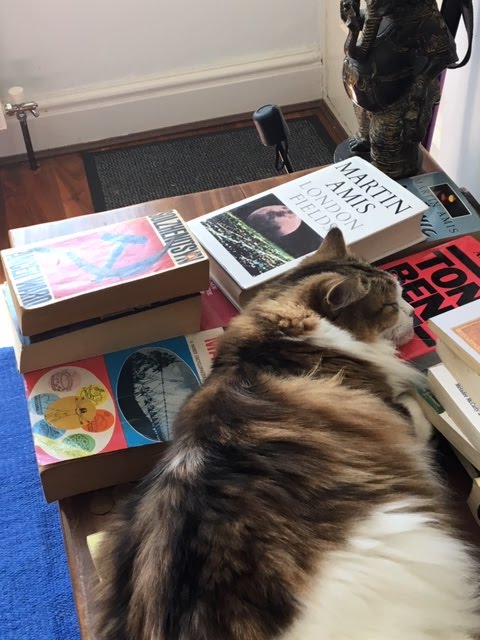
Boo boo in select company

Boo boo in select company
Something to say?

Wednesday, 7 December 2016

Money, Money, Moneeey...

Was definitely not funny, Chaos reigned with the de-monetisation, as they called it.

Last time I went to my bank in India my rather lovely bank manager gave me half my 'entitlement' (my money had become inaccessible overnight) for that week, and said, 'You don't really need more, do you?'  Made me think. 

 I was travelling all over India all of the next week and wondered whether I'd find myself in some god-forsaken village with no access to coffee-money. But she was right and I managed without. A quick exercise in budgeting. I bought one Paragon biriyani rather than two, which my greed required, and one packet of Halwa for gifts rather than two. I gave my maids old thousand-rupee notes, which they could legitimately change at the bank counter and felt a bit guilty. At the bank they may not get the same treatment I got - coffee with the manager and all services done by her very efficient assistants for me.

   In Chennai, though the new thousand and five-hundred notes had now arrived, people were still struggling. The taxi driver could not provide change and neither could the small way-side merchants from whom every-one usually bought their vegetables and fruit. They lost out.

   So did the fishermen in Kochi, who could not sell their catch to the local buyer.From day to day the goal-post was shifting and we had no idea what we could manage the next day. Back-packing tourists just gave up as they found they could not pay for way-side purchases. I waved my Barclaycard around a lot and lost hugely in the exchange. This could be done in the big stores only.

   The queues in the early weeks were long and exhausting; eventually people left a marker - chappals, plastic bag, newspaper... and sat near by. Rumours that a few millionaires had shifted huge mountains of money overseas weeks before the cash-drought made the average citizen very angry. And the farmers in remote villages did not even realise that their market-economy had gone bust, as they continued to trade in valueless paper money long after the demonetisation. 

   A wealthy friend of mine mentioned in passing that two BJP apparatchiks had asked him to launder money for them. He was amused.

   I am not a Modi supporter - God forbid. But I did think the fundamental idea was good though the execution was disorganised and untidy. It also hit the poor most.

   Then again - Indians are good at getting past rules. There is a whole underground network building up, finding ways to get past the new rules.

Why do I think only the poor got wiped out with this demonetisation trial? As usual?

Monday, 17 October 2016

The Ikea Experience

The Ikea experience
(For Val)
Two things reminded me of you recently. So this bit of writing is for you, Val Johnson. In this world where all my friends are high-end earners (and that includes my children) the only thing I can give that is worthwhile is my writing.

So I went to Ikea a few weeks ago. I needed nothing from there – or anywhere else – at that moment, but Manju needed shelving for her daughter’s room, so I tagged along like ballast. In India they would have called me Vattipalam, the side of the mango, the bit that is left when the two big fleshy bits have been cut off, but you don’t want to waste that thin sliver on either side. That about describes me. Can’t throw it away, but could well do without.

When I go to Ikea, I have to give myself a capped budget. It was fifty pounds this time, but for unknowable reasons the bill in the end was £82 pounds. Thank God for plastic money. What did I buy? Odd shaped pyrex dishes to look at and admire, not much use to serve anything much. A wok for stir-fries, of which we have three already. A mug for morning tea- a lovely one, blue flowers on white, cheap porcelain, chips if you breathe on it. Cost a pound. Can't complain.

Through it, especially when I saw the twisted Happy Ferns, I thought of you. I hope you and your family are happy and well.

Afterwards I had tea and a ham sandwich at the cafeteria. I fetched this myself as Manju was somewhere in the basement tackling flat-packs. If she was there I would have sat back, hugging age and let her do it all. In fact I get away with her doing a lot of things for me, which I can do myself: that tea at nine in the evening, driving me here and there, making my bed…

You and I, we used to sit at a window-table in Ikea, watching the world streaming in and out. I smiled at a few strangers, hoping for some signs of friendliness, but in this instance, failed. I have my victories. The other day I struck up an unlikely conversation with two jobbing gardeners I didn’t know from Adam. Notch one for Anand.


I feel someone should hold master classes for English people who are tight-arsed, wary of strange old biddies, who smile for no reason.  Teach them that smile should be the default position? You and I together?

Friday, 14 October 2016

I Have a Thing about Food

I have a thing about food. Amazing how old, child-hood hangups hang (sorry!) around. I am not able to waste that last half-spoon of rice at the bottom of the pan, the cold pizza left over from my grand-daughter's evening meal, the beef curry in which all the beef has been eaten and only gravy  (and what a gravy!) is left. Today I shall spend an hour making banana cake to resuscitate two almost-dead, spotted, large, sick bananas. And then I shall worry when the cake is still there three days from now. The life-span of banana cake is inversely proportional to the heating in the kitchen. And my daughter switched the heating on this week when she saw me digging out my winter-socks from the storage box.

   I remember the refugees from the partition of India. How ever did they reach this far South in Kerala? They spoke Hindi and communicated with hand-signals. This, of course was the time of serial starvation in India. I don't think the present generation of whizz-kids, rich on corporate salaries have any idea of what misery that was.
   
   The ragged, broken families went from house to house, standing mutely in front of the middle-class verandas. I would put my current book down and try to talk to them. All they did was make the universal sign of hunger, fingers supplicating in front of the mouth, eyes beseeching, while the children held on to the mother's clothes. That deluge of starving people carried on through the early fifties and died down very gradually. Now, there are no beggars in Thalassery, though you can still see them in bigger towns. They are locals, not broken families of homeless refugees.

   My grandmother got into the habit of saving the starchy water drained from the cooked rice. This was normally used to starch clothes, but she commandeered it for the beggars. She would take a big handful of rice from the pot furtively and put it into the thick water. She also kept the empty coconut shells to use as bowls for them. Disposable bowls, which could then be burned for fuel.

   One day I came upon my cousin Nani, scraping the bottom of the rice-pot late at night when all the others had gone to bed. It was 1944 and rationing was at its dismal worst. I had been asleep, but when I found her missing in the room, I crawled off my mat and went looking for her. When I saw what she was doing I picked up a wooden spoon to scrape with her. 'No,' she said, 'the neighbours should not hear us. They will know we are short of rice in a lawyer's house.' This was the time when my father was in jail for irritating the British Government with speeches and with leading protest marches.

   Devi, our maid lived next door in a small mud hut. She got the leftovers, all thrown into a bowl and left overnight. Generally bits of Okra, tiny bits of rice and lentils scraped from our evening meals. She took it home to feed her daughter, who was my age.

   So, to this day, I don't take food for granted. I cook too much, so there is no dearth. And then force my family to eat it for another meal, and then another.


Wednesday, 17 August 2016

The Affluence Disease

My friend from Thalassery complains about her granddaughter. 'Does your girl eat without coercion?' she asks. She has a tough time persuading her grandchild to eat anything.

   I comfort her. 'Mine is just as bad,' I say, 'but getting slightly better with each year. It's because they never went without. The house is always awash with food, yours and mine.We always rushed off to get them what they wanted, when they refused the food on the dinner table.'

   Today my lovely granddaughter asked for bacon for lunch when I offered the three-beans stew and rice on the table. I put my foot down gently. 'You have to eat what has been cooked,' I insisted. And she did. And loved it. I may make her that bacon for her next meal.

   All this choice and decision-making confuses me.  At home in Thalassery we had Moong and rice in one form or another for most meals, except lunch. The mid-day meal was Sambar and rice, catch-all vegetable gravies with whatever vegetable was there. Four-annas worth of fish was bought most days from the fish-man who trotted along with his catch each morning. The fishy water would be leaking on to the dirty head-cloth under the basket on his head, but the fish would be straight from the catch. Mostly sardines and mackerel, which would be made into a curry and may-be a few tail-ends fried for the men. Not much fish trickled down to the children of the house and the women, most of them were vegetarian anyway.

   They cooked small amounts - there was no 'frig and what was left over at the bottom of the pots would be given to the maid with a scraping of rice to take home to her family. She herself ate with us.

   Today, some days, I look at my 'frig and despair. It is crowded with food and no one is really anxious to eat. Even the dog is choosy.

   This needless plenty applies to everything in the house: clothes, furniture, books. Every now and then a huge bundle is taken away by a willing charity. But even charities will not tale old mattresses away. And the man who brings the skip to our house to take building rubble away reminds me sternly - no mattresses. I can't help thinking of Makeni in Sierra  Leone where I once had to destroy a mattress. 

   I came back from leave one summer and there was a huge, stinking rat squashed under my bed-spread. I got one of the boys in the flats below mine to take that mattress away. 'Please burn it, ' I said. He held his nose. ' Can I keep it, please?' 'It's gross, I answered. 'You don't want to sleep on that.' But he pleaded and the mattress became his prided possession. I never asked how he managed to clean it and mend the hole where the rat had been, but I saw it in his bedroom, when the boys got together there for a chin-wag. He was proud of that mattress.

Thursday, 7 July 2016

Age has its Advanages

After that little moan yesterday (right, big moan, if you insist) here I am searching for the illusory benefits of being old:

   I look at the gymnastics of the two major political parties and know this has all happened before. If not here in the U K , perhaps in India, Italy, Nigeria...

   All that horse-trading and and in-fighting  - the press must be really delighted. Now they don't have to go looking for news; news is coming to them in large and delicious rolls. Their tiny little right-wing minds cannot decide which bemused Tories to support - the ones honestly Tory in the Tory party, or the Tories in the Labour Party. Laura Keunssberg is having a blast - her lips curling, happy smile hovering, and the sentences drawn out to maximum selective brilliance. Doesn't the B B C give even lip-service to impartiality?

   I am asking myself: how is the Momentum caucus in Labour different from the 1922 Committee in the Conservative Party? Prime Ministers live in mortal fear of them; whole national referendums are organised to please them. Momentum can't even get the Eagle to behave herself, or indeed the self-indulgent Blairites to stop sulking.

   As with us old people, I escape into the past, remembering quite another U K. One in which it was not all about the bottom line, when people counted irrespective of colour or religion. 

   We celebrate the anniversaries of World Wars but forget how we plunged in to help small nations against bullies. 

   When did so much of the news become about shares and the preoccupations of big business? How many of us own shares, especially among the working classes? How many have enough savings to buy a new car, let alone put in £15240 into an ISA? 

   House prices going down? Great, I think. More people can afford the prices and the mortgages. House prices are a little ridiculous recently.

   Bankers a little lost? They can get more lost as far as I am concerned. They sit on our money and give us laughable interest rates while they gamble with our resources. And Carney just gave them a bit more to play with.

   This is a good time to think where we are headed, our much-lauded  British sense of values, which all immigrants have to sign up to. Except we really can't be much bothered with immigrants, can we? That is also recent.

Like a Czech friend of mine said, 'When we come to Britain, we are immigrants, when you come to our country, you are expatriates.' Bulls-eye, Theresa!


Wednesday, 6 July 2016

Older by the day.

Last year, when I saw my G P about sundry age-related ailments, she was quite encouraging. Vital statistics all reasonable, she said. Just cut down on those cheese toasties (with red Leicester specially) and walk for at least 20 minutes, five times in the week. On the whole a satisfactory encounter. (Be patient. Us oldies like talking about our insides, specially bowels, and we take time getting to the point. Restraint needed on the part of listening family.)

   As I got to the door, my G P asked, 'Not incontinent, are you?' That came out of the left field. So I answered without thinking. 'I have that to look forward to.' She has since left the practice. Mmmm... 

   This year it is all teeth - or lack of. Another spare part threatens. I counted - I am down to sixteen now and one more is soon destined for the chop. I can either wear dentures or stop smiling. I vote for the latter.

   But, I keep telling all who come up against me on a bad day, that I am still compus mentis. Or almost. Why do they look uncertainly at me?

Granted I list a bit when I walk and fall into the flower bed often when I walk on uneven flowerbeds. But why does my carpenter think I can't drive? Driving is a lot easier than walking on a wonky knee, and he will find that out when he reaches eighty.

   I do an audit: hearing reasonable, teeth fifty percent, but not the chewing ones, knee serviceable but just, eyes can read as fast as ever but after eight in the evening, they are untrustworthy.

   Which do I hate more? People not jumping up to do things for me (like that tenth cup of tea at ten at night) or doing too much assuming I am not functional.

Ah! the loss of control. I hate those airport wheel-chairs and the handlers that treat us oldies like laundry. Sad lumps to be pushed around and parked here and there.

Monday, 13 June 2016

The Hay Buzz

It's still with me - that excitement and optimism that Hay can generate in a book-mad person like me.

   It was busy - claustrophobic busy in the corridors.  It took fifteen minutes to go from one tent to another. But the quality of discourse Hay brings together year after year is amazing.

   I had the pleasure of listening among others, to Bridget Kendall on Russia, its current and past agendas with respect to to rest of the world, its wonders and our misunderstandings about it. She made Putin sound irrelevant.

   And then there was Dara O'Brian, almost 90 minutes of stand-up hilarity. Th audience, figured out his end-lines even before he reached them, so that he had to finish each joke amid laughter. 'You are laughing too soon. Hold on,' he pleaded.  

   The rains came down half-way through, like a deluge, beating on top of the Tata tent and making a quagmire of the fields where we camped. This was my very first experience of camping. I wish I had done all this earlier, when I could still get down to the floor-level futon without flopping on to the floor and crawling in. Also, to state the obvious, a private toilet would have been great. 

   In the Masai Mara national park in Kenya your camp has a toilet and shower for each tent and the beds are normal beds. I remember being totally spoilt. The hippos can be heard in the dark African night munching away at the grass just outside the back of the tent , which is on the river-bank. The monkeys set up a signalling system alerting all their mates when a lion is near and the elephants crunch at the palms and pull down the odd one for sport.

   However, I go to Hay for the intellectual excitement, the stimulus that makes me want to start writing as soon as I am within reach of my desk-top.

   It was fun to meet Lionel Shriver. I just finished reading the signed copy of her new novel, The Mandibles. Shades of 1984, I thought. She writes beautifully with an in-bred arrogance. I did not find her likeable, cold-blooded in fact. But I will forgive anything in honour of good writing.

   My daughter calls Hay the Davos of the thinking person. It certainly gets me thinking. The research from Cambridge university on the pathology as well as the functioning of the ageing human brain was interesting. I have a vested interest in this.

   I have already booked up for next year. A proper B and B with a bathroom at the end of the corridor.